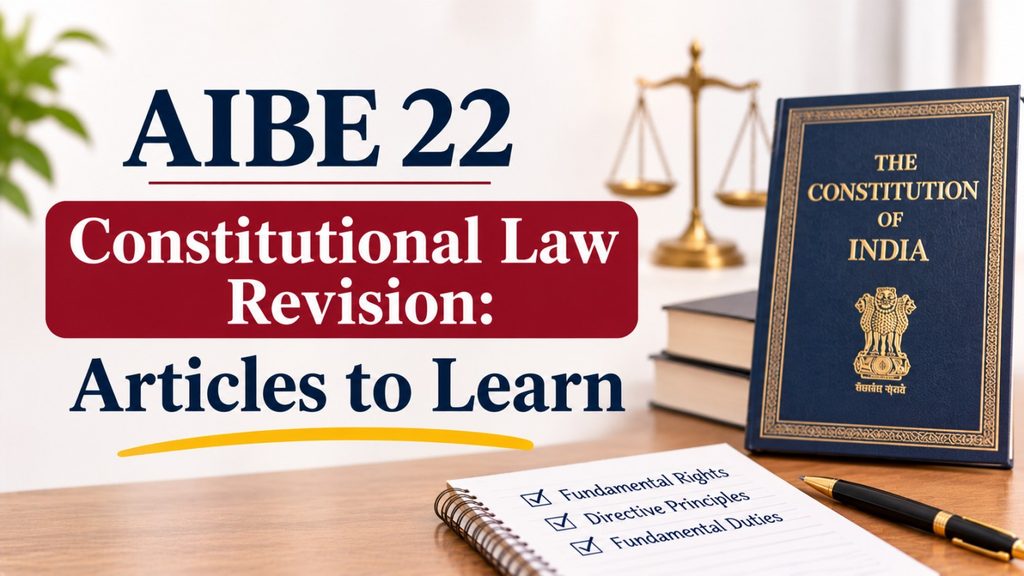
AIBE 22 Constitutional Law is one of three subjects carrying 10 questions each, so it is worth revising carefully. The All India Bar Examination (AIBE) is on 29 November 2026, and bare acts without notes are reportedly allowed, so knowing where each Article sits saves time. This guide is written for law graduates and final-year LL.B. students, and lists the Articles to learn in plain language.
Legal Background
- The Constitution of India is the supreme law. Every other law must follow it.
- The Advocates Act, 1961 governs the legal profession. Section 24 lists who can be enrolled as an advocate, and Section 49 lets the Bar Council of India (BCI) make rules.
- Passing AIBE leads to the Certificate of Practice under the BCI Certificate and Place of Practice (Verification) Rules, 2015.
How the Constitution Is Organised
Preamble (aims and values)
↓
Part III: Fundamental Rights (Arts 12 to 35)
↓
Part IV: Directive Principles (Arts 36 to 51)
↓
Part IVA: Fundamental Duties (Art 51A)
↓
Union, State, Judiciary, Emergency and Amendment
AIBE 22 Constitutional Law: Fundamental Rights to Learn
Fundamental rights are basic rights that you can enforce in court against the State.
| Article | What it says |
|---|---|
| 12 and 13 | Defines “State”; laws that violate fundamental rights are void |
| 14 | Equality before law and equal protection |
| 15 | No discrimination; 15(4), 15(5) and 15(6) allow special provisions and EWS reservation |
| 16 | Equal opportunity in public jobs |
| 17 | Untouchability abolished |
| 19 | Six freedoms, subject to reasonable restrictions |
| 20 | Protection from retrospective punishment, double punishment and forced self-incrimination |
| 21 | Life and personal liberty; 21A gives free education from age 6 to 14 |
| 22 | Safeguards on arrest and preventive detention |
| 23 and 24 | No trafficking, forced labour or child labour in hazardous work |
| 25 to 28 | Freedom of religion |
| 29 and 30 | Cultural and educational rights of minorities |
| 32 | Right to approach the Supreme Court |
Writs: Articles 32 and 226
A writ is a court order to enforce a right. The Supreme Court issues them under Article 32, and High Courts under Article 226, which is wider.
| Writ | Meaning |
|---|---|
| Habeas corpus | Produce a detained person before the court |
| Mandamus | Command a public body to perform its duty |
| Prohibition | Stop a lower court acting beyond its power |
| Certiorari | Quash a lower court or body’s order |
| Quo warranto | Ask by what authority someone holds a public office |
Directive Principles and Duties
- Directive Principles guide the State but are not directly enforceable. Learn Article 39A (free legal aid), 44 (uniform civil code), 48A (environment) and 50 (separating the judiciary from the executive).
- Fundamental Duties are in Article 51A, added by the 42nd Amendment, 1976.
Union, State and Federal Provisions
- Articles 245 and 246: law-making powers, divided by the Seventh Schedule into Union, State and Concurrent Lists.
- Article 254: repugnancy, meaning what happens when Union and State laws on a Concurrent subject conflict.
- Article 246A: GST, added by the 101st Amendment.
- Articles 53, 74 and 75: the President, the Council of Ministers and the Prime Minister.
- Articles 153 and 163: the Governor and the Governor’s powers.
- Articles 123 and 213: ordinances, meaning temporary laws made when the legislature is not sitting.
Parliament, Judiciary and Emergency
| Topic | Articles |
|---|---|
| Money Bills | 110 |
| Joint sitting | 108 |
| Supreme Court and its binding law | 124 and 141 |
| Special leave to appeal | 136 |
| High Courts and supervision of lower courts | 214 and 227 |
| National emergency | 352 |
| State emergency (President’s rule) | 356 |
| Financial emergency | 360 |
| Amendment procedure | 368 |
During a national emergency, Article 359 allows suspension of enforcing certain rights, but Articles 20 and 21 cannot be suspended.
Recent Amendments to Revise
- 103rd Amendment (2019): adds Articles 15(6) and 16(6) for Economically Weaker Section (EWS) reservation.
- 101st Amendment (2016): introduces GST under Article 246A.
- 106th Amendment (2023): provides for one-third reservation for women in the Lok Sabha and State Assemblies.
The basic structure doctrine, developed by courts, limits Parliament’s power under Article 368.
Constitutional Bodies
- Article 324: Election Commission
- Article 148: Comptroller and Auditor General
- Article 315: Public Service Commissions
- Article 280: Finance Commission
Revision Tips
- Read the Articles’ wording in your bare act, since AIBE 22 Constitutional Law questions test exact phrases.
FAQs
About 10 of the 100 questions, per reported weightage.
Articles 14, 19, 21, 32, 226 and 368.
Yes, it is among the most tested Articles.
Article 32 is for the Supreme Court, and Article 226 is for High Courts and is wider.
No.
Some of the top books for AIBE:
- R.V. Kelkar’s Lectures on Criminal Procedure: Based on Bharatiya Nagarik Suraksha Sanhita, 2023
- V. P. Sarathi’s Law of Evidence: Based on Bharatiya Sakshya Adhiniyam, 2023
- B.M. Gandhi’s Penal Law: Covering Bharatiya Nyaya Sanhita 2023, Dowry Prohibition Act, JJ Act, MTP Act, POCSO Act, DV Act, and More
- EBC’s Master Guide To All India Bar Examination (AIBE Exam Guide)
- All India Bar Examination Bare Acts Without Notes and Comments | AIBE Bare Acts Combo Set of 25 Books | Covering Old and New Criminal Laws
- All India Bar Examination – Solved Papers 2015-2025
- Universal’s Guide to All India Bar Examination | AIBE Complete Syllabus Guide