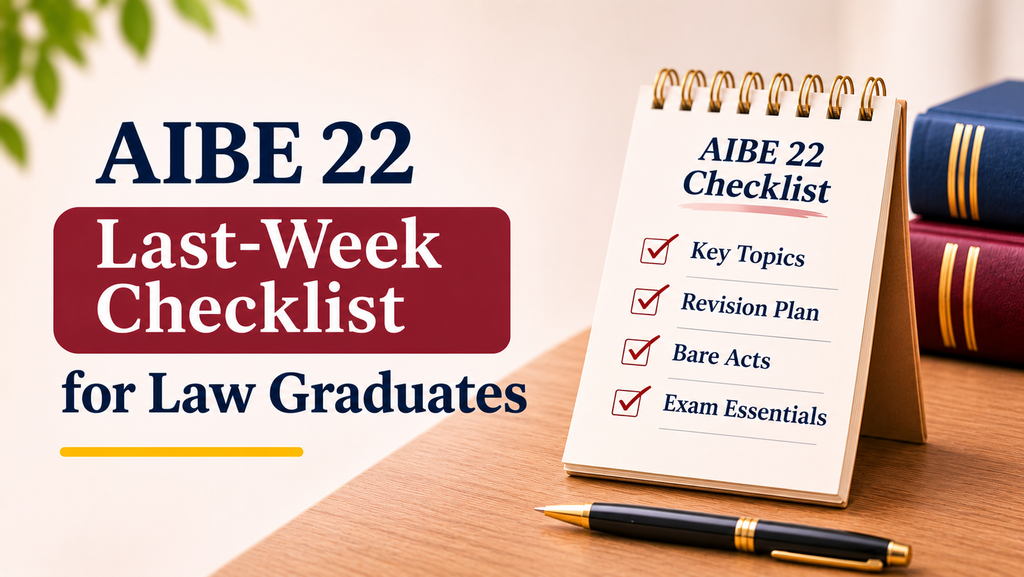
With the All India Bar Examination (AIBE) XXII scheduled for November 29, 2026, law graduates are entering the final preparation stretch. A structured AIBE 22 last-week checklist ensures that administrative compliance, statutory readiness, and exam-hall discipline are fully aligned before test day.
Statutory and Regulatory Framework Governing AIBE 22
The AIBE is not a routine university test; it is a statutory licensing requirement determining your right to practise law across India. Several central laws and Bar Council of India (BCI) regulations govern your eligibility, permitted materials, and conduct during the examination:
- Advocates Act, 1961: Section 24 sets out the qualifications required to be admitted as an advocate on a State roll. Sections 29 and 33 restrict the right to practise before courts and tribunals exclusively to enrolled advocates. Under Section 49(1)(ah), the BCI is empowered to prescribe the conditions subject to which an advocate shall have the right to practise, forming the legal foundation for conducting the AIBE.
- Bar Council of India Rules (Part VI, Chapter III, Rules 9 to 11): Inserted in 2010, these rules mandate passing the AIBE to obtain a Certificate of Practice (the official credential granting permanent permission to practise law in Indian courts). Under Rule 10(1)(b), provisional enrolment granted by a State Bar Council remains valid for only two years, within which the candidate must pass the exam.
- Bharatiya Nyaya Sanhita (BNS), 2023: Replaced the Indian Penal Code as India’s primary criminal statute. Sections 318 (cheating) and 319 (cheating by personation) criminalize fraudulent acts such as sending an impostor to write the exam or forging admit cards.
- Rights of Persons with Disabilities (RPwD) Act, 2016: Section 17 and related accessibility guidelines mandate reasonable accommodations, including compensatory time and scribe facilities, for eligible candidates with benchmark disabilities (40% or more).
Main article: AIBE 22 Exam 2026: Complete Guide to Dates, Registration, Syllabus, and Eligibility
Final Seven-Day Countdown Workflow
Nov 22–24: Download Admit Card & Audit Personal Details
│
▼
Nov 25–26: Audit Bare Acts (Remove Commentary & Stray Notes)
│
▼
Nov 27: Verify Photo ID, Stationery & Scribe Documents
│
▼
Nov 28: Reconnaissance of Exam Centre Route & Travel Time
│
▼
Nov 29: Report 90 Minutes Early (Exam Window: 1:00 PM – 4:00 PM)
Mandatory Documents and Exam-Day Materials
Because the AIBE 22 admit card went live on November 14, 2026, candidates must download and inspect it immediately. If you spot any discrepancy in your name, photograph, or category, contact the BCI helpdesk before test day.
| Item Category | Permitted Items | Prohibited Items (Grounds for Disqualification) |
| Identity & Entry | Two printed copies of the AIBE 22 Admit Card; original government photo ID (Aadhaar, Voter ID, Passport, or Driving Licence) | Digital screenshots on phones; expired or photocopied ID proofs |
| Statutory Texts | Unannotated Bare Acts (the exact statutory text published by the legislature without external commentary) | Bare Acts with commentary, case-law digests, handwritten notes, textbooks, or loose papers |
| Writing & Time | Blue or black ballpoint pens; simple analogue wristwatch | Pencils, gel pens, whitener/correction fluid, digital watches, or smartwatches |
| Special Categories | PwD Certificate and scribe declaration/ID documents (if applicable) | Unapproved scribes or scribes holding law/political science qualifications |
Rights, Obligations, and Penalties Under BCI Rules
Understanding your exact obligations inside the examination hall prevents inadvertent rule violations:
- Bare Act Compliance: Under BCI open-book guidelines, only Bare Acts without notes are permitted as of right. If pure Bare Acts are unavailable, Bare Acts containing minimal “short notes” are allowed strictly at the invigilator’s discretion. Remove sticky notes containing handwritten summaries, as invigilators routinely confiscate annotated copies.
- OMR Sheet Accuracy: AIBE 22 is an offline, pen-and-paper test of 100 multiple-choice questions across three hours. Bubbling an incorrect Roll Number or Question Booklet Set Code on the Optical Mark Recognition (OMR) sheet can lead to outright rejection of your answer script.
- Zero Negative Marking: Every correct answer earns one mark, and wrong or blank answers carry zero penalty. Attempt all 100 questions, reserving the final 25 minutes for reviewing flagged statutory lookups.
- Penalties for Unfair Means: Possessing mobile phones, Bluetooth devices, or prohibited study guides triggers immediate cancellation of candidature. Beyond exam disqualification, the BCI can initiate disciplinary proceedings for professional misconduct (unethical or unlawful conduct unbecoming of an advocate) under Section 35 of the Advocates Act, 1961, alongside criminal prosecution under the BNS, 2023.
Frequently Asked Questions (FAQs)
Yes. The AIBE 22 syllabus covers both the repealed codes (IPC, CrPC, Indian Evidence Act) and the new enactments (BNS, BNSS, BSA). Carry clean, unannotated copies of both sets.
No. You must carry a clear physical printout of your admit card alongside an original photo ID.
Contact the official BCI AIBE helpdesk immediately via the phone numbers or email listed on the portal to request rectification before November 29, 2026.
No. Pencils are strictly prohibited on OMR sheets and may invalidate your paper. Use only a blue or black ballpoint pen.
The exam runs from 1:00 PM to 4:00 PM. Candidates should reach the venue at least 90 minutes early (by 11:30 AM) to complete biometric and document verification before gates close.
You May Also Like:
AIBE 22 Exam 2026: Complete Guide to Dates, Registration, Syllabus, and Eligibility