The Open-Book Trajectory: Statutory Background & Exam Mandate
The All India Bar Examination, conducted by the Bar Council of India (BCI), evaluates an advocate’s baseline fitness to practice law across Indian courts. Section 24 of the Advocates Act, 1961 establishes the statutory criteria for enrolment on a State Bar roll. To regulate practice standards, the Bar Council of India Certificate and Place of Practice (Verification) Rules, 2015, read with Section 49(1)(ag) of the Advocates Act, 1961, make passing the AIBE compulsory to retain a valid Certificate of Practice (COP).
Main article: AIBE 22 Exam 2026: Complete Guide to Dates, Registration, Syllabus, and Eligibility
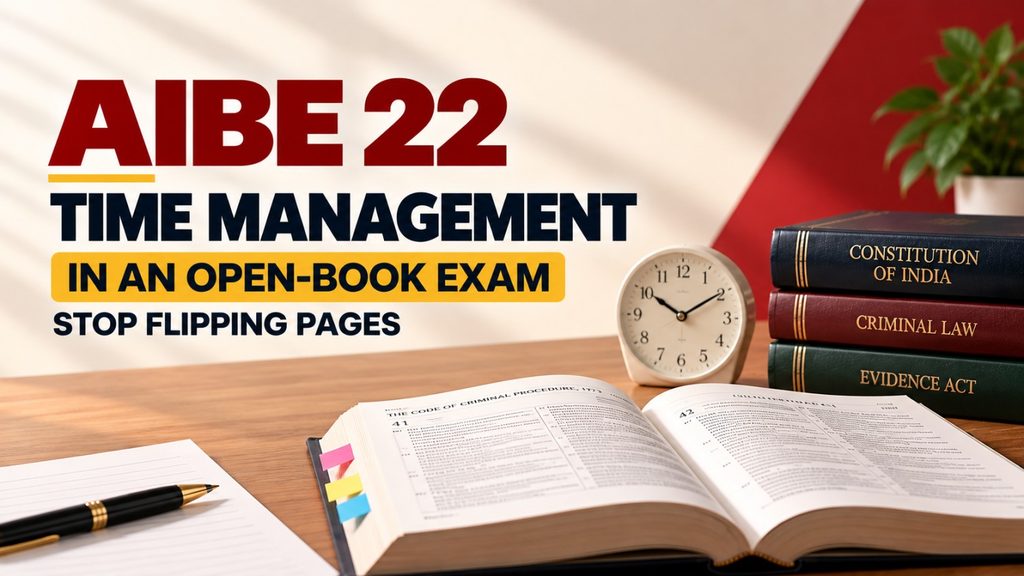
Many candidates fall into the trap of treating the AIBE 22 open book exam as an easy exercise where answers can simply be looked up on the spot. The paper contains 100 multiple-choice questions (MCQs) to be solved within 210 minutes (3.5 hours), granting approximately 2.1 minutes per question. Candidates who rely entirely on searching every question in physical statutory texts—known as Bare Acts (the plain, official text of an Act passed by Parliament without commentary or explanatory notes)—invariably run out of time. Mastering time management requires knowing how statutes are framed and relying on statutory indexing rather than aimless page flipping.
Regulatory Rules: What Bare Acts Are Permitted?
Under official BCI examination instructions, candidates are permitted to carry statutory Bare Acts into the exam hall, but strict compliance rules apply:
- Permitted Materials: Plain Bare Acts without short notes, commentary, or extensive annotations. Clean photocopies or official government PDF printouts of statutes are also permitted.
- Prohibited Materials: Textbooks, guidebooks, handwritten digests, study notes, and electronic devices (mobile phones, smartwatches, calculators) are strictly barred.
- Marking Restrictions: Light pencil underlining, minor highlighting, or small tick marks are usually permissible, but heavy writing, attached notes, or pasted sheets will lead to confiscation at the examination center.
With the replacement of legacy penal statutes by the Bharatiya Nyaya Sanhita, 2023 (BNS), Bharatiya Nagarik Suraksha Sanhita, 2023 (BNSS), and Bharatiya Sakshya Adhiniyam, 2023 (BSA) on July 1, 2024, candidates must carry updated editions reflecting these current statutory regimes along with core procedural laws like the Code of Civil Procedure, 1908 (CPC).
Comparative Breakdown: Bare Act Preparation vs. Time Efficiency
| Strategy Domain | Inefficient Approach (Page Flipping) | Efficient Approach (Index Navigation) |
| Search Method | Searching page-by-page from Section 1 onward. | Consulting the “Statement of Sections” or Index at the front of the Bare Act. |
| Resource Reliance | Carrying 25+ separate, thick commentaries. | Carrying plain Bare Acts and multi-statute subject manuals (e.g., Labour or IP manuals). |
| Answering Workflow | Opening the Bare Act for all 100 questions immediately. | Applying the 3-Pass Method: answering memorized items first, then verifying doubtful ones. |
| Ethics & Rules | Ignoring high-weightage minor statutes like BCI Rules. | Securing easy marks in Section 35 of the Advocates Act, 1961 and BCI Professional Standards. |
Tactical Execution: Stop Flipping and Start Solving
To maximize performance in the AIBE 22 open book exam, candidates should structure their exam time using a proven three-pass approach:
- Pass 1 (60 Minutes – Direct Attempt): Go through all 100 questions and attempt every item you know from memory—such as Fundamental Rights under Articles 12–35 of the Constitution of India, general contractual principles under the Indian Contract Act, 1872, or basic limitation periods. Do not open a single Bare Act during this pass.
- Pass 2 (100 Minutes – Index-Based Lookup): Target questions requiring exact section numbers, definitions, or statutory exceptions. Turn directly to the table of contents or index at the beginning of the respective Bare Act to identify the relevant chapter and section within seconds.
- Pass 3 (50 Minutes – Verification & Completion): Address complex procedural queries in BNSS or CPC. Since there is no negative marking, ensure every circle on the Optical Mark Recognition (OMR) sheet is filled completely using a black or blue ballpoint pen.
Statutory Disqualifications, Misconduct, and Remedies
Carrying unauthorized materials or violating examination instructions incurs strict penalties under the BCI examination guidelines.
- Disqualification & Cancellation: Possessing prohibited commentaries, written notes, or electronic devices can lead to immediate cancellation of the candidate’s paper and referral to the Bar Council for unfair means.
- Consequences of Failure: Failing the AIBE disables an advocate from practicing in court beyond their initial provisional enrolment period. Under Section 45 of the Advocates Act, 1961, practicing in any court without proper enrolment or right to practice carries a potential penalty of imprisonment for up to six months.
- Remedial Recourse: Candidates who do not pass or whose results are withheld due to OMR set-code errors may apply for OMR re-checking or reappear in the subsequent AIBE cycle as permitted by the BCI.
Frequently Asked Questions (FAQs)
No. It is strictly an “open Bare Act exam.” Only plain statutory texts without commentary or explanatory notes are permitted inside the examination hall.
Yes. Clean photocopies or printouts of official statutory text downloaded from official portals are allowed, provided they contain no added notes.
Official instructions mandate Bare Acts without notes. Bare Acts containing minimal short notes may only be allowed at the center superintendent’s strict discretion if plain copies are unavailable, but carrying plain copies is strongly advised to prevent risk.
No. There is no negative marking for incorrect answers, so candidates should attempt all 100 questions.
The passing criterion is typically 45% for General/OBC candidates and 40% for SC/ST candidates.
Some of the top books for AIBE:
- R.V. Kelkar’s Lectures on Criminal Procedure: Based on Bharatiya Nagarik Suraksha Sanhita, 2023
- V. P. Sarathi’s Law of Evidence: Based on Bharatiya Sakshya Adhiniyam, 2023
- B.M. Gandhi’s Penal Law: Covering Bharatiya Nyaya Sanhita 2023, Dowry Prohibition Act, JJ Act, MTP Act, POCSO Act, DV Act, and More
- EBC’s Master Guide To All India Bar Examination (AIBE Exam Guide)
- All India Bar Examination Bare Acts Without Notes and Comments | AIBE Bare Acts Combo Set of 25 Books | Covering Old and New Criminal Laws
- All India Bar Examination – Solved Papers 2015-2025
- Universal’s Guide to All India Bar Examination | AIBE Complete Syllabus Guide