India’s new criminal code needs a plain-language guide
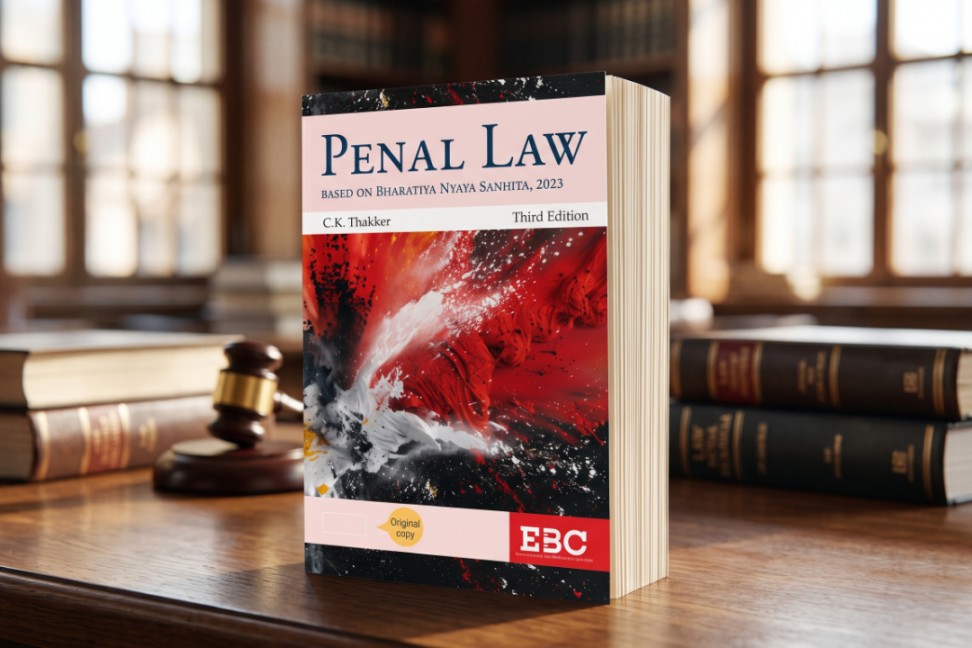
Since 1 July 2024, the Bharatiya Nyaya Sanhita, 2023 (BNS) has replaced the Indian Penal Code, 1860 as India’s main law defining crimes and punishments. Justice C.K. Thakker’s Penal Law: Based on Bharatiya Nyaya Sanhita, 2023 (3rd Edition, 2026, Eastern Book Company) is a textbook written for this new code.
This post covers what the book contains, who it is meant for, and what to check before buying. It draws on the publisher’s description and contents list, so it is an overview, not a review of the full text.
The book at a glance
The 3rd Edition (2026) is a 632-page book, sold as a paperback or eBook, and priced at ₹761 on EBC Webstore as of 12 October 2026.
| Detail | What the publisher’s page lists |
|---|---|
| Title | Penal Law: Based on Bharatiya Nyaya Sanhita, 2023 |
| Author | C K Thakker (described in the overview as Justice C.K. Thakker) |
| Edition | 3rd Edition, 2026 |
| Publisher | Eastern Book Company |
| Pages | 632 |
| Format | Paperback / eBook |
| Language | English |
| ISBN | 9788168089112 |
| Size | 23.1 x 16.1 x 2.9 cm |
| Jurisdiction | India |
| Price (EBC Webstore) | ₹761, down from ₹895 (15% off), free delivery |
| Earlier edition | 2nd Edition, 2022, based on the IPC: ₹421, down from ₹495 |
Prices change, so check the product page before ordering.
The BNS in brief: what changed from the IPC
The BNS received the President’s assent on 25 December 2023 and came into force on 1 July 2024, replacing the IPC of 1860. Its sibling laws came into force the same day: the Bharatiya Nagarik Suraksha Sanhita (BNSS) replaces the Code of Criminal Procedure, 1973, and the Bharatiya Sakshya Adhiniyam (BSA) replaces the Indian Evidence Act, 1872.
- Size: the BNS has 358 sections in 20 chapters, against 511 sections in 23 chapters in the IPC.
- New offences: these include organised crime (section 111), petty organised crime (section 112), terrorist act (section 113) and snatching (section 304).
- Omissions: offences such as sedition, adultery and attempt to commit suicide are not part of the BNS.
- Grouping: offences against women and children, scattered across the IPC, are brought together in Chapter V.
- Penalties: per Vikaspedia’s overview, punishment is enhanced for 33 offences, fines are increased for 83, and community service is available for 6 petty offences.
- Old cases: offences committed before 1 July 2024 continue to be dealt with under the IPC.
This context matters for the book because several BNS provisions are new and have little or no judicial interpretation yet, a point the publisher stresses.
What the book sets out to do
According to the publisher, this is an introductory text that explains the BNS in a simple, clear style. It was conceived because law students, young practitioners and general readers had limited material for understanding the basic principles of criminal law.
The publisher highlights four design choices:
- Coverage of new provisions: the BNS drops several obsolete IPC provisions and adds new offences for changing social, economic and technological conditions. Because many of these are recent and have little or no case law, the authors explain their scope and purpose by reference to what the legislature intended.
- Historical background: the authors draw on sources such as the Code Makers’ view and reports of the Law Commission of India.
- Chapter openers: each chapter begins with selected quotations meant to frame the themes that follow.
- Audience: the publisher describes it as useful for law students, academicians, legal practitioners and anyone who wants to understand India’s criminal law framework.
Chapter-by-chapter contents
The book has 20 chapters, a Table of Cases at the front and a Subject Index at the end. These are the book’s own chapter numbers, not BNS chapter numbers, since chapter 2 (“Why Nyaya Sanhita, 2023”) is the book’s own discussion rather than a section of the Act.
| 1 | Fundamental Principles of Criminal Law | Foundations |
| 2 | Why Nyaya Sanhita, 2023 | Foundations |
| Book chapter | Topic | Group |
|---|---|---|
| 3 | Title, Commencement and Applicability | Foundations |
| 4 | Definitions | Foundations |
| 5 | Punishments | Foundations |
| 6 | General Exceptions | Foundations |
| 7 | Abetment | Criminal liability beyond the act itself |
| 8 | Criminal Conspiracy | Criminal liability beyond the act itself |
| 9 | Attempt | Criminal liability beyond the act itself |
| 10 | Offences Against Women and Children | Specific offences |
| 11 | Offences Affecting Human Body | Specific offences |
| 12 | Offences Against State and Society | Specific offences |
| 13 | Offences By or Against Public Servants | Specific offences |
| 14 | Offences Against Public Justice | Specific offences |
| 15 | Offences Affecting Public Health, Safety, Convenience, Decency and Morality | Specific offences |
| 16 | Offences Relating to Religion | Specific offences |
| 17 | Offences Against Property | Specific offences |
| 18 | Offences Relating to Documents and Property Marks | Specific offences |
| 19 | Criminal Intimidation, Insult, Annoyance, and Defamation | Specific offences |
| 20 | Repeal and Savings | Transition |
The “Group” column is added here for readability; the publisher lists the chapters in a single sequence.
Who it is for, and what to pair it with
The publisher positions the book for readers who want a clear first understanding of the BNS rather than an exhaustive commentary.
- Law students: the stated core audience, since the book was conceived to fill a gap in beginner-level material.
- Young practitioners: it can serve as a quick orientation to the new code’s structure and its new offences.
- Academicians: the historical references and chapter-opening quotations may suit teaching and background reading.
- General readers: the publisher says it also targets laypersons who want to understand criminal law.
The BNS only covers offences and punishments. For procedure and evidence, the store’s “Good Together” bundle pairs this book with V. P. Sarathi’s Law of Evidence (based on the BSA) and R.V. Kelkar’s Lectures on Criminal Procedure (based on the BNSS).
Before you buy: what to weigh
This is a good fit if you want an accessible first read of the BNS, and a weaker fit if you need deep case-law analysis. Four points are worth checking.
- It calls itself introductory. The publisher describes it as an introductory text, so researchers and litigators who need exhaustive case-law treatment may want a larger commentary alongside it.
- No reader reviews yet. The product page showed 0 reviews as of 12 October 2026, and the store lists the book as added on 7 October 2026, so there is little independent feedback to go on.
- New provisions are interpretive. The publisher itself notes that many BNS provisions have little or no judicial precedent, so any explanation of them rests on legislative intent. Verify points of law against the Act and recent judgments.
- Alternatives exist on the same store. The page lists B.M. Gandhi’s Penal Law (covering the BNS plus the Dowry Prohibition Act, JJ Act, MTP Act, POCSO Act and DV Act, among others) and P.S.A. Pillai’s Criminal Law. This post does not compare their contents with this book.
Frequently asked questions
The 3rd Edition (2026) is based on the BNS. The 2nd Edition (2022) was based on the IPC, so it does not cover the new code.
The contents list shows no chapters on procedure or evidence. Those subjects fall under the BNSS and the BSA, which the store sells as separate books.
Yes, it is available.
This book is for law students, young practitioners, academicians and general readers who want to understand India’s criminal law. It was conceived because beginner-level material on the subject was limited.
Want a deeper dive? Grab the book!