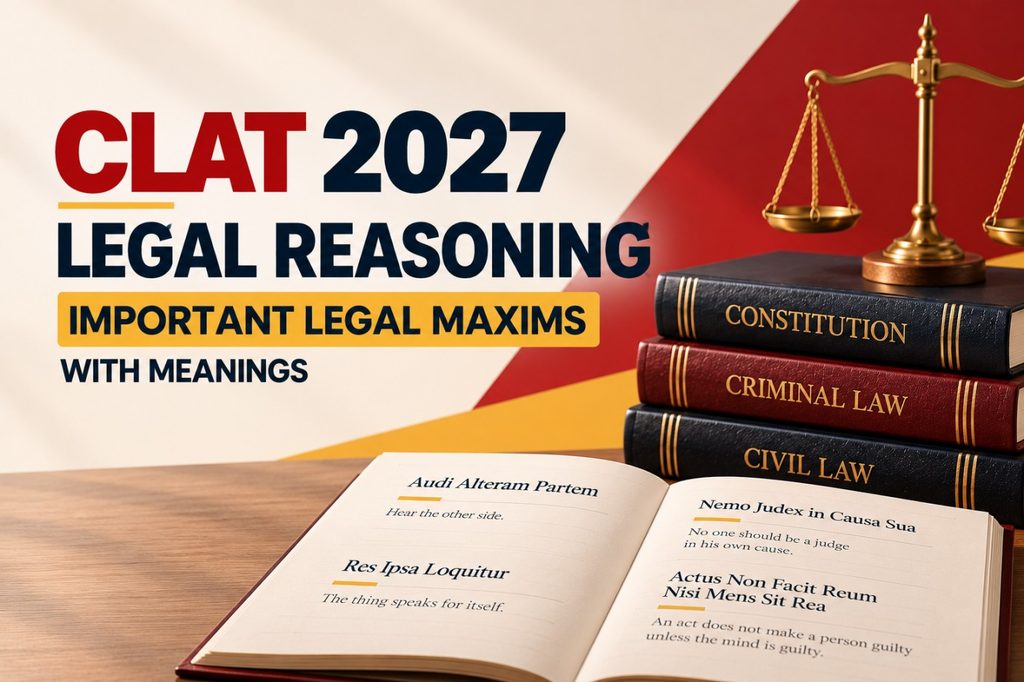
A legal maxim is a short Latin saying that sums up a settled legal principle. If you are preparing for CLAT 2027 legal reasoning, knowing the common maxims helps you spot the rule hidden inside a passage. This guide is written for Class 12 students, so each term is explained in plain words and linked to the Indian law behind it. CLAT 2027 is scheduled for 6 December 2026.
main article: CLAT 2027 Syllabus & Exam Pattern: Subject-Wise Weightage & Changes
Why Legal Maxims Matter
The legal reasoning section gives you a principle and a set of facts, then asks you to apply one to the other. You are not expected to know law beforehand, but maxims give you a head start. Learn the meaning and one example of each, not just the Latin.
Maxims From Criminal Law
- Actus non facit reum nisi mens sit rea (an act is not a crime unless the mind is guilty): Most offences under the Bharatiya Nyaya Sanhita, 2023 (BNS), India’s main criminal code, need a guilty mind, shown by words like “intentionally” or “knowingly”. The guilty mind is called mens rea.
- Ignorantia juris non excusat (ignorance of law is no excuse): BNS Section 14 protects a person who acts under a mistake of fact, but not a mistake of law.
- Volenti non fit injuria (no wrong is done to a consenting person): Consent can excuse some acts, but with limits, especially for serious harm. The BNS general exceptions (Sections 14 to 44) set those limits.
Maxims From the Law of Torts
A tort is a civil wrong, such as negligence, that is mostly not written in a single Indian statute.
- Res ipsa loquitur (the thing speaks for itself): The accident itself suggests carelessness. The related criminal provision is BNS Section 106, which punishes death caused by a rash or negligent act.
Maxims From Contract and Sale Law
- Pacta sunt servanda (agreements must be kept): The Indian Contract Act, 1872 lists the elements of a valid contract in Section 10 and requires parties to perform their promises in Section 37.
- Caveat emptor (let the buyer beware): Section 16 of the Sale of Goods Act, 1930 generally puts the duty of checking quality on the buyer, with exceptions. The Consumer Protection Act, 2019 gives remedies for defective goods.
- Nemo dat quod non habet (no one gives what they do not have): Under Section 27 of the Sale of Goods Act, a buyer generally gets no better title than the seller had, subject to exceptions.
Maxims From Constitutional and Procedural Law
- Ubi jus ibi remedium (where there is a right, there is a remedy): Articles 32 and 226 of the Constitution of India, 1950 allow writs (court orders) to enforce rights. Section 9 of the Code of Civil Procedure, 1908 lets civil courts hear all civil suits unless barred.
- Audi alteram partem (hear the other side): Article 311(2) requires a reasonable chance to be heard before a civil servant is dismissed.
- Nemo judex in causa sua (no one should judge their own cause): This is the rule against bias, part of fair procedure under Article 14.
A Maxim From Interpretation
- Ejusdem generis (of the same kind): General words after a list take their meaning from that list. In “knives, swords and other weapons”, “other weapons” likely means sharp weapons. The General Clauses Act, 1897 holds the basic rules for reading Indian laws.
Commonly Confused Pairs
| Pair | The difference |
|---|---|
| Damnum sine injuria vs injuria sine damno | Loss without a legal wrong (no remedy) vs a legal wrong without loss (remedy, such as a voter wrongly refused entry) |
| Audi alteram partem vs nemo judex | The right to be heard vs the right to an unbiased decision-maker |
| Mistake of fact vs mistake of law | May excuse (BNS Section 14) vs does not excuse |
| Actus reus vs mens rea | The guilty act vs the guilty mind |
| Caveat emptor vs consumer remedy | Buyer checks the goods vs the law protects against defects |
How to Use a Maxim in a CLAT Question
Read the principle → Spot the maxim or rule → Match it to the facts
→ Check exceptions → Eliminate options that add outside law
FAQs
No, but they help you grasp principles faster.
Start with 20 to 30 core ones.
The guilty mind or intention behind an act.
Apply the rule in the passage.
In bare acts, available free from government websites.