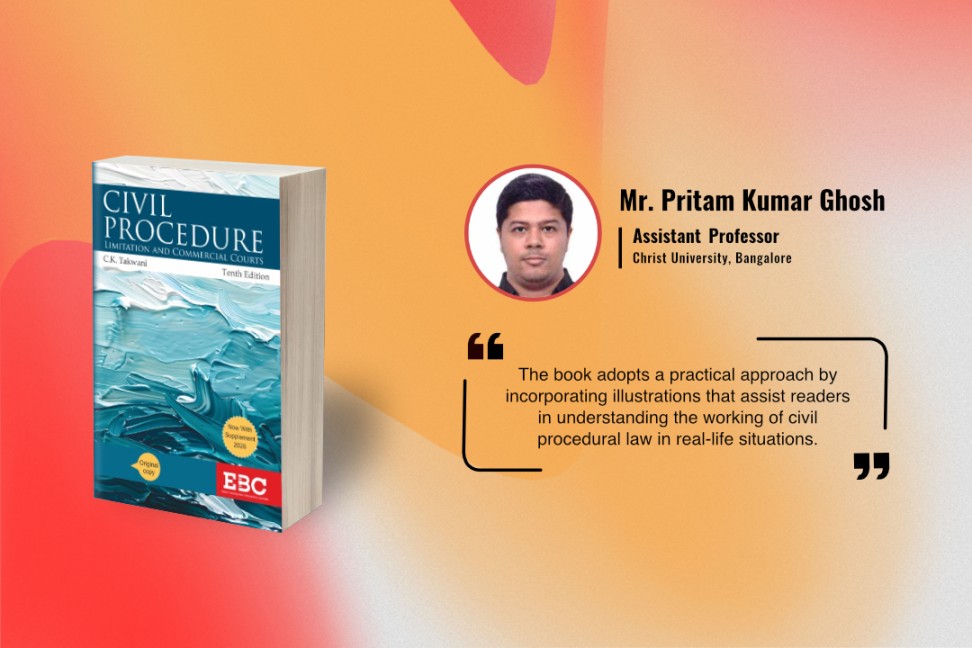
The Code of Civil Procedure (CPC) provides the procedural framework through which civildisputes are adjudicated before Indian courts. Understanding its provisions requires not only familiarity with the statutory sections and Orders but also an appreciation of how these provisions are interpreted and applied by courts in different factual circumstances. Against this background, Takwani’s Civil Procedure provides a comprehensive treatment of the provisions of the CPC, supported by landmark and recent judicial decisions. The book also adopts a practical approach by incorporating illustrations that assist readers in understanding the working of civil procedural law in real-life situations.
Comprehensive Coverage of the Provisions of the CPC
One of the notable features of the book is its comprehensive coverage of the relevant provisions of the Code of Civil Procedure. The book deals with the various sections and Orders of the CPC, providing readers with a structured understanding of the statutory framework governing civil procedure.
For students of law, studying the CPC involves understanding the relationship between individual provisions and their practical application. The treatment of the provisions in the book therefore provides a foundation for understanding the procedural framework within which civil litigation takes place.
The comprehensive coverage also makes it possible for readers to approach the CPC not merely as a collection of statutory provisions but as a procedural framework that governs different stages and aspects of civil proceedings.
Landmark and Recent Case Laws
An important aspect of the book is its coverage of both landmark and recent case laws relating to the provisions of the CPC. Judicial interpretation plays an important role in understanding procedural provisions, particularly where the practical application of a statutory provision depends upon the factual circumstances of a case.
The book analyses case laws relating to the provisions covered, helping students understand how statutory rules have been interpreted and applied by Indian courts. This case-law orientation is particularly useful because it enables readers to appreciate the connection between the text of the CPC and its application in actual disputes.
The inclusion of both landmark as well as recent decisions also provides readers with an opportunity to understand the development of procedural principles through judicial decisions.
Understanding the Practical Application of Civil Procedure
A significant feature highlighted in the review is the use of real-life illustrations. Civil procedure can often appear technical when studied only through statutory language. Illustrations can help bridge the gap between the theoretical understanding of procedural provisions and their practical operation.
The book provides illustrations from a real-life perspective, helping students understand how civil procedural law works in Indian courts at the ground level. This practical orientation can assist readers in relating statutory provisions to the kinds of circumstances that arise in actual civil proceedings.
For students encountering procedural law as an academic subject, such illustrations can make it easier to understand how provisions operate in different factual situations and how procedural principles are applied in practice.
Connecting Statutory Provisions with Judicial Application
The study of the CPC requires an understanding of both the statutory text and judicial interpretation. A provision may have a specific statutory formulation, but its practical application is often understood through the decisions in which courts have considered that provision in particular factual circumstances.
By combining the relevant provisions with case-law analysis and practical illustrations, the book provides readers with a framework for understanding this relationship between statutory provisions, judicial decisions and practical circumstances.
This approach is particularly relevant for students who are required to understand not only what a particular provision states, but also how it operates when applied to real disputes.
Relevance to Civil and Commercial Disputes
The practical relevance of the CPC extends across a wide range of civil and commercial disputes. Procedural rules determine how parties approach civil litigation and how courts deal with various procedural questions arising during the course of proceedings.
The review observes that the book presents a comprehensive picture of the application of the CPC to real-life civil and commercial disputes that have come before the Indian judiciary. The discussion of provisions alongside judicial decisions therefore helps readers appreciate the role of procedural law in actual litigation.
This practical dimension adds relevance to the study of the CPC, particularly for readers seeking to understand how procedural provisions operate beyond the classroom.
Cross-Border Civil and Commercial Disputes
One area identified for further development in a future edition is the application of CPC provisions in cross-border civil and commercial disputes. Cross-border disputes can involve additional procedural questions concerning the recognition and enforcement of foreign judgments and the interaction between the procedural framework of Indian courts and principles relating to international judicial cooperation. The review specifically suggests that a future edition could include relevant illustrations and case laws concerning the application of CPC provisions in cross-border civil and commercial disputes. Such material would provide readers with an opportunity to understand how procedural provisions operate when disputes involve parties, judgments or legal proceedings connected with jurisdictions outside India.
Section 13 and the Recognition of Foreign Judgments
The review particularly refers to Section 13 of the CPC, which is regularly applied by Indian courts in the context of cross-border disputes.
The application of Section 13 is relevant to questions concerning the recognition and enforcement of foreign judgments in India and the principle of comity of courts. Including relevant illustrations and judicial decisions dealing with these issues in a future edition could further assist readers in understanding the practical application of the CPC in cross-border civil and commercial matters.
For students and readers interested in international civil and commercial disputes, such examples could provide a useful connection between the statutory framework of the CPC and the procedural issues that arise when legal proceedings or judgments involve more than one jurisdiction.
A Practical Learning Resource for Students
The combination of statutory provisions, judicial decisions and practical illustrations gives them book particular relevance for students studying civil procedure. The CPC contains numerous procedural provisions that may initially appear technical or difficult to relate to actual litigation. The use of case laws and illustrations can help students move from an abstract understanding of procedural rules towards an appreciation of their practical application.
The book’s discussion of real-life civil and commercial disputes further supports this approach by demonstrating the relationship between procedural rules and the circumstances in which those rules are applied before Indian courts.
Usefulness for Understanding Judicial Reasoning
The study of case law is important not only for identifying the legal position but also for understanding the reasoning through which courts apply procedural provisions to particular facts. The book’s inclusion and analysis of landmark as well as recent case laws enables readers to examine how courts have approached different provisions of the CPC. This can help students understand the development and application of procedural principles through judicial decisions. Such an approach is also relevant for readers who wish to develop a deeper understanding of how statutory provisions function within the broader framework of civil litigation.
Scope for Further Enrichment
While the book provides comprehensive coverage of the CPC, the review identifies a specific area in which a future edition could be further enriched: cross-border civil and commercial disputes.
The inclusion of additional illustrations and case laws concerning Section 13, the principle of comity of courts, and the recognition and enforcement of foreign judgments in India would provide an additional practical dimension to the treatment of civil procedure. Such material would complement the existing focus on real-life disputes and further demonstrate how CPC provisions can be applied to increasingly complex civil and commercial situations.
Bridging Academic Study and Practical Understanding
Another important aspect of studying civil procedure is developing the ability to connect procedural rules with the factual circumstances of a dispute. The book’s use of illustrations and case-law analysis contributes to this understanding by showing how provisions of the CPC are applied in situations that arise before Indian courts. This approach can help readers appreciate that civil procedure is not limited to the study of individual sections and Orders, but also concerns the manner in which those provisions operate together in the course of actual litigation.
Understanding the CPC in a Changing Legal Landscape
The discussion of both landmark and recent case laws also enables readers to approach the CPC through the evolving body of judicial interpretation. As civil and commercial disputes continue to present varied factual and procedural questions, understanding the application of statutory provisions through judicial decisions remains an important part of legal education. The book’s combination of statutory provisions, case-law analysis and practical illustrations therefore provides readers with a broader framework for studying civil procedure and appreciating its application in real-life disputes.
Overall Assessment
Overall, the book presents a comprehensive picture of the application of the CPC to real-life civil and commercial disputes that have come before the Indian judiciary. Its coverage of the relevant sections and Orders, combined with landmark and recent case laws and practical illustrations, provides readers with a structured approach to understanding civil procedural law. The emphasis on the application of statutory provisions in different factual circumstances further contributes to its practical orientation. The book therefore brings together three important aspects of studying civil procedure: the statutory framework, judicial interpretation and practical application.
Takwani’s Civil Procedure provides a comprehensive treatment of the Code of Civil Procedure, with attention to the relevant statutory provisions, landmark and recent judicial decisions, and practical illustrations. The book’s focus on real-life civil and commercial disputes helps readers understand how procedural law operates in the Indian judicial system and how statutory provisions are applied in different factual circumstances., The review also identifies an important avenue for further development in a future edition through greater coverage of cross-border civil and commercial disputes, particularly in relation to Section 13 of the CPC, the principle of comity of courts, and the recognition and enforcement of foreign judgments in India. Overall, the book presents a comprehensive picture of the application of the CPC to real-life civil and commercial disputes that have come before the Indian judiciary, making the connection between statutory provisions, judicial interpretation and their practical application an important feature of its treatment of civil procedure
Want the deeper dive? Grab the reference book.