The CLAT UG 2027 Syllabus & Exam Pattern is governed by the Consortium of National Law Universities (NLUs), an autonomous administrative body formed to standardize national-level admissions into premier law universities across India. Admission to executive undergraduate law programs (such as B.A. LL.B. Honors) is regulated under statutory frameworks governing higher education institutions, alongside rules framed under the Advocates Act, 1961 through the Bar Council of India (BCI).
The Common Law Admission Test (CLAT) serves as a centralized evaluation mechanism designed to assess candidates’ aptitude, critical thinking, and legal reasoning abilities rather than rote memorization of statutory provisions. Candidates appearing for CLAT 2027 will be evaluated through a passage-based offline test.
Core Legal Framework & Regulatory Foundations
While the CLAT exam tests candidate aptitude, the examination process is anchored in administrative and regulatory rules:
- Bar Council of India Rules (Legal Education Rules, 2008): Prescribes the minimum educational qualifications required for admission to professional law courses. Candidates must possess a Senior Secondary School Pass Certificate (Class 12 or equivalent) from a recognized board.
- Consortium Governance By-Laws: Regulates the conduct of examinations, registration timelines, tie-breaking protocols, and seat allocations.
- Rights of Persons with Disabilities Act, 2016: Mandatory statutory provisions ensure reservation, extra time allowances (compensatory time of 40 minutes for a 2-hour exam), and scribe assistance for Persons with Benchmark Disabilities (PwBD).
- Article 14 and Article 15 of the Constitution of India: Defines the constitutional mandates governing non-discrimination and affirmative action policies (reservations) in seat allotment across central and state NLUs.
Key Changes in Syllabus for CLAT 2027
The Consortium of NLUs has not changed the syllabus or exam pattern for CLAT 2027. Legal Reasoning passages remain self-contained, so no prior legal knowledge is needed. However, passages may draw on recent legislation, so it helps to know these three new laws, which replaced the older statutes:
- Transition to New Criminal Laws: Standard legal reasoning passages no longer apply the repealed colonial-era statutes—the Indian Penal Code (IPC), Code of Criminal Procedure (CrPC), and Indian Evidence Act. Questions are now framed around their statutory replacements:
- Bharatiya Nyaya Sanhita, 2023 (BNS): Replaces substantive penal provisions (IPC). Introduces newly codified offences like mob lynching, organised crime, and snatching, while substituting community service for minor infractions.
- Bharatiya Nagarik Suraksha Sanhita, 2023 (BNSS): Replaces procedural law (CrPC). Focuses on modernised investigation rules, statutory Zero FIRs, e-FIRs, and strict timelines for trials.
- Bharatiya Sakshya Adhiniyam, 2023 (BSA): Replaces evidence rules (Indian Evidence Act). Elevates electronic and digital records directly to primary evidence.
- Focus on Contemporary Judicial Developments: Passages in Legal Reasoning and Current Affairs increasingly evaluate statutory amendments, constitutional bench rulings, public policy reforms, and modern statutory enactments (such as data protection frameworks).
- Qualitative Shift in Passage Design: Rather than testing static recall of section numbers, CLAT 2027 passages present a self-contained legal rule extracted from modern statutes and evaluate the candidate’s skill in applying that rule to complex factual scenarios.
Visit the Official Consortium of NLUs Syllabus Page.
Section-Wise Breakdown & Marks Distribution
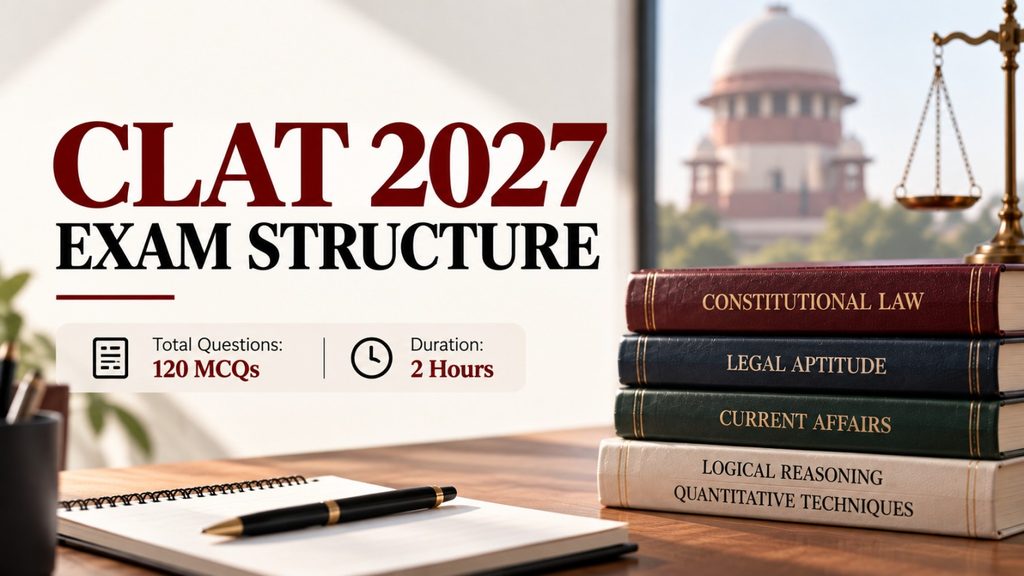
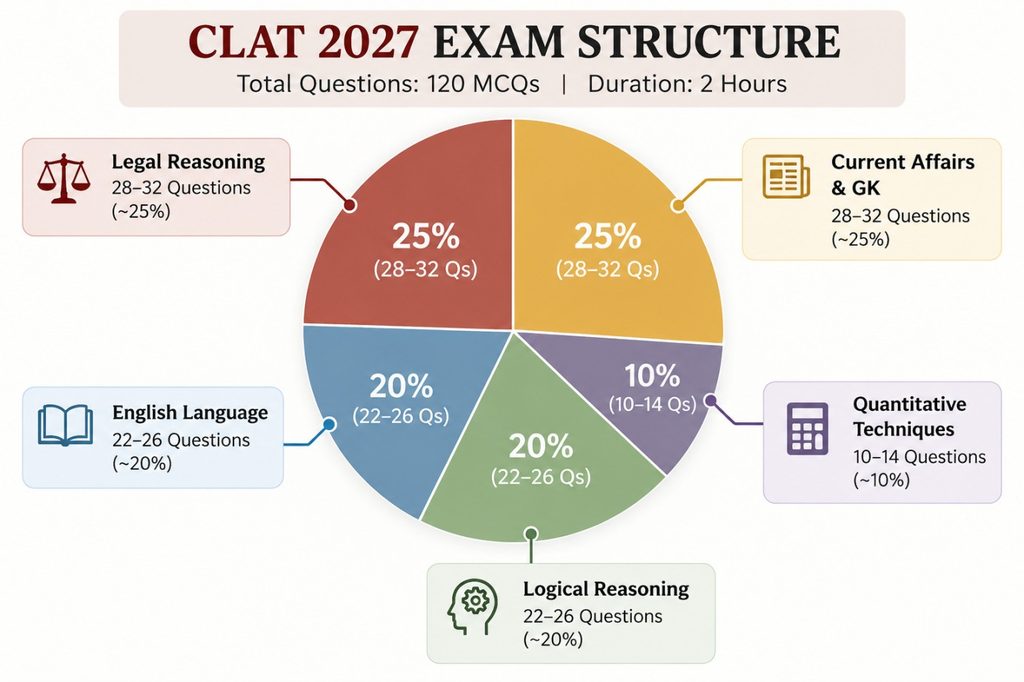
The entrance examination consists of 120 multiple-choice questions (MCQs) to be solved within 2 hours (120 minutes). Each correct response earns +1 mark, while an incorrect answer incurs a penalty of -0.25 marks (negative marking).
| Exam Section | Approximate Question Count | Weightage (%) | Core Skills Tested |
| Legal Reasoning | 28–32 | ~25% | Application of legal principles to factual situations; reading legal passages. |
| Current Affairs & GK | 28–32 | ~25% | National/international events, public policy, and static general knowledge. |
| English Language | 22–26 | ~20% | Reading comprehension (~450-word passages), vocabulary, and inferences. |
| Logical Reasoning | 22–26 | ~20% | Critical thinking, evaluating arguments, premises, and conclusions. |
| Quantitative Techniques | 10–14 | ~10% | Class 10 basic mathematics, data interpretation, ratios, and percentages. |
| Total | 120 Questions | 100% | 2 Hours (120 Minutes) Offline Mode |
Key Exam Requirements & Eligibility
To register for the CLAT 2027 Syllabus & Exam Pattern, candidates must satisfy clear statutory and administrative conditions:
- Educational Qualification: Passing Class 12 or equivalent with a minimum percentage requirement (typically 45% marks for Unreserved/OBC/PwBD categories and 40% for SC/ST categories).
- Upper Age Limit: As per current regulations following BCI guidelines and judicial directives, there is no upper age limit for appearing in the undergraduate CLAT examination.
- Objection & Redressal Mechanism: Following the exam, the Consortium publishes a provisional answer key. Candidates can raise objections within a stipulated window by paying a prescribed fee per question.
CLAT UG 2027 Important Dates
| Event | Date |
|---|---|
| Notification released | 22 July 2026 |
| Registration opens | 3 August 2026, 10 AM |
| Last date to apply | 31 October 2026 |
| Admit card | By about 25 November 2026 (reported) |
| Exam | Sunday, 6 December 2026, 2:00 PM to 4:00 PM |
| Provisional answer key | Within 24 to 48 hours of the exam (expected) |
| Result | Around 20 December 2026 (expected) |
| Counselling | Soon after the result, in multiple rounds (expected) |
Application Fee and How to Apply
The fee is ₹4,000 for General, OBC and EWS candidates and ₹3,500 for SC and ST candidates. Sources disagree on whether PwD and BPL candidates also get the lower fee, so check the notification. Apply only on consortiumofnlus.ac.in:
- Create an account with your mobile number and email, then verify the OTP.
- Fill in personal and academic details.
- Choose three preferred test cities.
- Upload a recent passport-size colour photo and your signature in black ink on white paper.
- Pay the fee online and save the confirmation page.
Keep your Class 10 and 12 marksheets, category certificate and disability certificate (if applicable) ready.
Visit https://consortiumofnlus.ac.in/clat-2027/ to register now.
Detailed Section-Wise Syllabus
- English Language: Passages of about 450 words on fiction, non-fiction and journalism. Questions test comprehension, inference, summary, vocabulary in context and tone.
- Current Affairs and GK: Passages from newspapers and journals. Topics include national and international events, arts and culture, and historically significant events.
- Legal Reasoning: Passages on legal matters, public policy and moral questions. You apply the stated principle to a given fact situation.
- Logical Reasoning: Passages on arguments. You identify premises and conclusions, spot flaws, judge analogies and find contradictions.
- Quantitative Techniques: Class 10 maths, presented as short passages, tables or graphs. Topics include ratios, percentages, averages and basic algebra.
Exam-Day Rules
- Carry your admit card and a valid photo ID.
- Electronic devices, calculators and study material are not allowed.
- Reach the centre by the reporting time on the admit card.
- The exam is pen and paper, so mark answers carefully on the OMR sheet.
After the Exam: Answer Key, Result and Counselling
The Consortium publishes a provisional key, considers objections, then publishes the final key and result with your rank and category. Counselling is online and conducted in five rounds, according to Shiksha. You register, choose NLU preferences and freeze or upgrade your seat in each round. A seat-confirmation fee is paid, and it is adjusted against the university fee. Seats are allotted by rank, category and preference. Keep your proof of Class 12 marks ready, because failing to submit it leads to cancellation of admission.
Frequently Asked Questions (FAQs)
The exam is 2 hours long (120 minutes) and carries a total of 120 marks across 120 passage-based questions.
No. The official syllabus emphasizes that prior legal knowledge is not required. All facts and legal principles needed to answer the questions are provided within the passages.
Yes, a negative marking of 0.25 marks is deducted for every incorrect response. Unattempted questions receive zero marks.
Legal Reasoning and Current Affairs (including General Knowledge) carry the highest weightage, accounting for approximately 25% each (~50% of the paper combined).
Yes. Candidates appearing for their Class 12 board examinations are eligible to register, provided they submit proof of passing at the time of NLU admission counseling.
Recommended Reads: