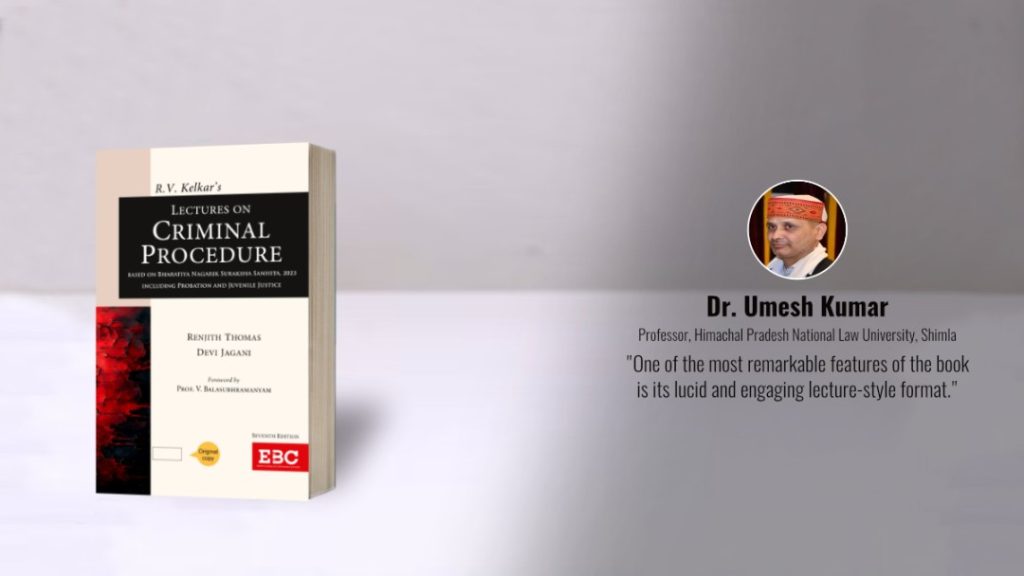
With the introduction of the Bharatiya Nagarik Suraksha Sanhita (BNSS), Indian criminal procedure stands at a defining crossroads, making authoritative academic guidance indispensable. R.V. Kelkar’s Lectures on Criminal Procedure, now in its 7th edition, remains one of the most trusted texts in this domain. In this review, Prof. Umesh Kumar of Himachal Pradesh National Law University, Shimla, examines how well the book navigates the transition from the CrPC to the BNSS framework, assessing its continued relevance for students, practitioners, and the judiciary.
The transformation of India’s criminal justice framework through the enactment of the Bharatiya Nagarik Suraksha Sanhita, 2023 (BNSS) has created an urgent need for authoritative academic resources that can help students and practitioners navigate the new procedural landscape. In this context, the 7th Edition of R.V. Kelkar’s Lectures on Criminal Procedure, revised by Renjith Thomas and Devi Jagani, emerges as an invaluable and timely contribution to legal scholarship
A Classic Text Reimagined for Contemporary Criminal Law
For decades, Prof. R.V. Kelkar’s work has been regarded as one of the most respected textbooks on criminal procedural law in India. Renowned for its lecture-based style and conceptual clarity, the book has consistently helped generations of law students understand the intricacies of criminal procedure. The latest edition successfully preserves the strengths of the original work while incorporating the significant procedural changes introduced under the BNSS. The revision ensures that readers can seamlessly transition from the erstwhile Code of Criminal Procedure to the new legal framework without losing sight of the foundational principles that continue to govern criminal justice administration.
Clarity Through a Lecture-Based Approach
One of the most remarkable features of the book is its lucid and engaging lecture-style format. The authors explain every stage of criminal proceedings, from investigation and arrest to inquiry, trial, judgment, and appeal, in a manner that is both systematic and accessible. Rather than overwhelming readers with statutory language, the book breaks down complex procedural concepts into understandable discussions, enabling students to grasp the rationale behind legal provisions. This approach encourages conceptual understanding and analytical thinking, making it particularly useful for classroom learning and self-study.
Bridging Statutory Law and Judicial Interpretation
The book effectively combines statutory provisions with leading judicial decisions, offering readers a comprehensive understanding of criminal procedure. By integrating important case law with legislative developments, the authors demonstrate how procedural rules have evolved through judicial interpretation and practical application. This balanced treatment allows readers to appreciate not only the letter of the law but also its implementation within the broader criminal justice system. The analytical approach adopted throughout the text strengthens the reader’s ability to engage critically with procedural issues and legal developments.
An Essential Resource for the BNSS Transition
The 7th Edition is especially significant because it addresses the needs of students and professionals adapting to the Bharatiya Nagarik Suraksha Sanhita, 2023. At a time when quality academic resources on the new procedural code are still emerging, this edition provides a reliable and comprehensive guide to understanding the changes introduced under the BNSS. The revised content helps readers identify procedural innovations, understand legislative intent, and appreciate the continuity and departures from the previous legal regime. For students preparing for examinations and judicial service aspirants seeking clarity on the new law, the book serves as an indispensable companion.
Why This Book Continues to Be a Favourite
The enduring popularity of R.V. Kelkar’s Lectures on Criminal Procedure lies in its logical organization, clear language, and student-friendly presentation. The text avoids unnecessary complexity while maintaining academic rigor, making it equally valuable for beginners and advanced learners. Its emphasis on conceptual clarity over rote memorization enables readers to develop a deeper understanding of criminal procedure and its practical significance within the justice system. This quality has cemented the book’s reputation as a trusted resource across law schools and legal institutions in India
The 7th Edition of R.V. Kelkar’s Lectures on Criminal Procedure, revised by Renjith Thomas and Devi Jagani, successfully carries forward the legacy of one of India’s most celebrated legal textbooks. Combining clarity, scholarly depth, and contemporary relevance, it provides a comprehensive guide to criminal procedure in the era of the BNSS.
For law students, judicial service aspirants, academicians, and legal practitioners, this book remains an essential reference work. Its thoughtful revision, accessible style, and authoritative treatment of procedural law make it one of the finest resources available for mastering the principles and practice of criminal procedure in India.