When an employee faces allegations of misconduct, employers often conduct a domestic enquiry to determine whether disciplinary action is justified. At the same time, some cases may also involve criminal proceedings before a court of law.
Although both processes may arise from the same incident, the standard of proof, procedure, and purpose of a domestic enquiry are very different from those of a criminal case. Understanding this distinction is important for employers, HR professionals, employees, and legal practitioners.
What is a Domestic Enquiry?
A domestic enquiry is an internal investigation conducted by an employer against an employee accused of misconduct such as:
- Theft
- Fraud
- Harassment
- Absenteeism
- Insubordination
- Data misuse
- Workplace violence
- Breach of company policies
The objective is to determine whether the employee violated service rules or company regulations and whether disciplinary action is necessary.
Domestic enquiries are governed by:
- Principles of natural justice
- Employment contracts
- Standing Orders
- Service rules
- Labour laws
They are not criminal trials and do not require strict court procedures.
What is a Criminal Case?
A criminal case is a legal proceeding initiated by the State against an accused person for committing an offence under criminal law, such as:
- Theft under IPC/BNS
- Assault
- Criminal breach of trust
- Fraud
- Sexual offences
- Cybercrime
The purpose of a criminal trial is to determine guilt and impose punishment such as imprisonment, fine, or both.
Criminal proceedings are governed by:
- Bharatiya Nyaya Sanhita (BNS)
- Bharatiya Nagarik Suraksha Sanhita (BNSS)
- Indian Evidence Act principles (now Bharatiya Sakshya Adhiniyam)
- Constitutional safeguards
Standard of Proof: The Core Difference
1. Standard of Proof in Domestic Enquiries
In domestic enquiries, the standard of proof is based on:
“Preponderance of Probability”
This means the enquiry officer decides whether the misconduct is more likely than not to have occurred.
The employer does not need to prove the allegation with absolute certainty.
Example:
If evidence shows there is a strong probability that the employee committed misconduct, disciplinary action may be justified even if there is some doubt remaining.
This is a comparatively lower standard of proof.
2. Standard of Proof in Criminal Cases
In criminal law, the standard of proof is:
“Beyond Reasonable Doubt”
This is a much stricter standard.
The prosecution must establish the guilt of the accused so convincingly that there remains no reasonable doubt in the mind of the court.
If reasonable doubt exists, the accused gets the benefit of doubt and may be acquitted.
Why Are the Standards Different?
The difference exists because the consequences are different.
| Domestic Enquiry | Criminal Case |
|---|---|
| Concerned with employment discipline | Concerned with criminal liability |
| May result in warning, suspension, dismissal | May result in imprisonment or criminal punishment |
| Internal employer process | Judicial process before a court |
| Flexible procedures | Strict legal procedures |
| Probability-based findings | Proof beyond reasonable doubt |
Since criminal punishment affects personal liberty and reputation, courts require stronger evidence.
Can Domestic Enquiry and Criminal Proceedings Run Together?
Yes. Both proceedings can continue simultaneously because they serve different purposes.
An employer is not always required to wait for the outcome of a criminal trial before conducting disciplinary proceedings.
However, in certain complex cases involving identical facts and serious criminal charges, employers may choose to keep the enquiry pending until the criminal case progresses.
Courts have repeatedly held that:
- Domestic enquiries and criminal trials are independent.
- Acquittal in a criminal case does not automatically invalidate disciplinary action.
- Departmental action can still be sustained if misconduct is proved on the balance of probabilities.
Important Judicial Principles
Indian courts have consistently clarified the distinction between standards of proof in departmental and criminal proceedings.
Some well-recognized principles include:
- Strict rules of evidence do not fully apply to domestic enquiries.
- Circumstantial evidence may be sufficient in disciplinary proceedings.
- Criminal acquittal does not necessarily entitle reinstatement.
- Employers must still follow principles of natural justice.
Principles of Natural Justice in Domestic Enquiries
Even though the standard of proof is lower, fairness remains essential.
The employee must be:
- Given a chargesheet
- Informed about allegations
- Allowed to present a defence
- Permitted to cross-examine witnesses where applicable
- Given access to relevant documents
- Heard by an unbiased enquiry officer
Failure to follow natural justice may invalidate the enquiry.
Evidence in Domestic Enquiries vs Criminal Trials
Domestic Enquiries
Evidence rules are more flexible:
- Emails
- CCTV footage
- Internal reports
- Attendance records
- Digital communication
- Witness statements
Technical rules of admissibility are relaxed.
Criminal Cases
Evidence must satisfy strict legal standards:
- Proper admissibility
- Chain of custody
- Formal proof
- Witness examination under law
Improperly obtained or unreliable evidence may be rejected.
Frequently Asked Questions (FAQs)
1. What is the standard of proof in a domestic enquiry?
The standard is “preponderance of probability,” meaning misconduct is considered proved if it is more likely than not to have occurred.
2. What is meant by “beyond reasonable doubt”?
It means the prosecution must prove the accused’s guilt so clearly that a reasonable person would have no substantial doubt.
3. Can an employee face both a domestic enquiry and a criminal case?
Yes. Both proceedings can run simultaneously because they have different objectives and legal standards.
4. Does acquittal in a criminal case mean the employee must be reinstated?
Not necessarily. An employer may still take disciplinary action if misconduct is established during the domestic enquiry.
5. Are strict evidence rules applicable in domestic enquiries?
No. Domestic enquiries follow more flexible evidentiary rules compared to criminal courts.
6. Can hearsay evidence be considered in a domestic enquiry?
Limited reliance may be placed on hearsay evidence if it has reasonable credibility, though findings should ideally be supported by substantive material.
7. Why is the burden of proof lower in domestic enquiries?
Because the consequences involve employment discipline rather than criminal punishment or loss of liberty.
8. What happens if principles of natural justice are violated?
The disciplinary proceedings may be challenged before labour courts or judicial forums and can be set aside.
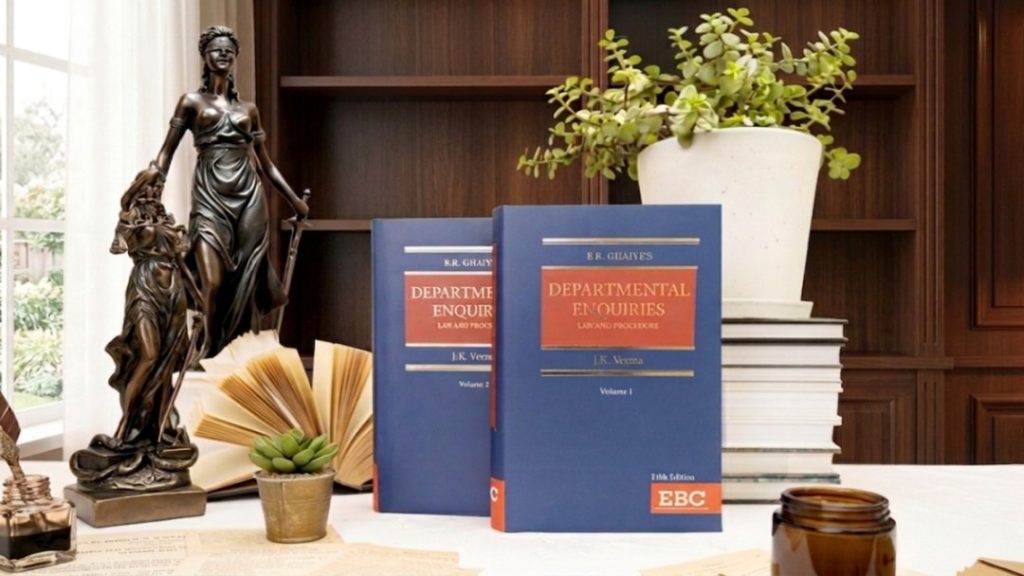
For further reading and detailed analysis, refer to this resource.