


In any court case, what ultimately matters is not merely what happened, but what can be proved in accordance with law. Evidence law lays down the legal rules that determine which facts may be presented before a court, how those facts must be proved, and who bears the responsibility of proving them. These rules ensure fairness, reliability, and consistency in judicial decision-making. India’s evidence framework has recently undergone a major transformation with the enactment of the Bharatiya Sakshya Adhiniyam, 2023, which replaces the colonial-era Indian Evidence Act, 1872. The new law modernises evidence rules, especially in relation to electronic and digital records, while retaining the foundational principles of relevancy, proof, and burden of proof. This article explains these core concepts in a clear and practical manner.
What Is Evidence?
Evidence refers to any material placed before the court to prove or disprove a fact. It generally includes:
- Oral evidence (statements of witnesses)
- Documentary evidence (written or recorded documents)
- Electronic evidence (emails, messages, digital files, CCTV footage, call records)
The law treats electronic records at par with documentary evidence, subject to authenticity and reliability requirements.
Relevancy of Facts
Meaning
Only relevant facts are admissible in court. A fact is relevant if it has a logical connection with a fact in issue and helps the court decide the case.
Courts exclude irrelevant, remote, or speculative material even if it appears interesting or emotionally persuasive.
Facts in Issue
Facts in issue are the principal facts that must be proved or disproved to determine the rights or liabilities of the parties.
Example: In a murder case, whether the accused caused the death is a fact in issue.
How Facts Become Relevant
A fact may be relevant if it:
- Forms part of the same transaction
- Shows motive, intention, preparation, or conduct
- Explains or introduces a fact in issue
- Establishes identity or relationship
- Amounts to an admission or confession
Relevancy vs Admissibility
Relevancy refers to logical connection.
Admissibility refers to legal permission.
A fact may be relevant but still inadmissible if the law prohibits its use.
Proof and Standard of Proof
Meaning of Proof
A fact is said to be proved when the court believes it to exist or considers its existence so probable that a reasonable person would act upon it.
Standards of Proof
Criminal Cases: Proof beyond reasonable doubt
Civil Cases: Preponderance of probabilities
This means criminal cases require a much higher level of certainty.
Burden of Proof
General Rule
The person who asserts a fact must prove it.
- In criminal cases, the prosecution bears the initial burden.
- In civil cases, the plaintiff bears the initial burden.
Shifting of Burden
Once one party establishes certain foundational facts, the burden may shift to the opposite party to rebut them.
Special Burdens
In specific situations, the law places the burden on the accused or defendant, such as proving exceptions, special knowledge, or alibi.
Oral Evidence
- Must be direct
- Witness must have personally perceived the fact
Hearsay evidence is generally inadmissible, subject to limited exceptions.
Documentary Evidence
Includes contracts, letters, records, and electronic documents.
Two categories:
- Primary evidence (original document)
- Secondary evidence (copies or substitutes in permitted situations)
Electronic Evidence
Electronic records such as emails, WhatsApp messages, CCTV footage, and digital photographs are admissible if authenticity and integrity are established through prescribed procedures.
Presumptions
Courts may presume certain facts, such as:
- Regularity of official acts
- Authenticity of certified documents
- Existence of natural events
Presumptions simplify trials and reduce unnecessary proof.
Why Evidence Law Matters
Evidence law:
- Prevents wrongful convictions
- Protects the innocent
- Promotes fair trials
- Ensures judicial decisions are reasoned and objective
Without evidence law, justice would depend on suspicion rather than proof.
Laws Governing Evidence in India
Evidence law in India operates through a combination of substantive and procedural statutes:
Bharatiya Sakshya Adhiniyam, 2023
The principal law governing evidence in India. It regulates admissibility, relevancy, proof, presumptions, and recognition of electronic and digital evidence.
Bharatiya Nagarik Suraksha Sanhita, 2023
Governs investigation and criminal procedure, including recording of statements, search and seizure, examination of witnesses, and production of evidence in criminal trials.
Bharatiya Nyaya Sanhita, 2023
Defines offences relating to giving false evidence, fabricating evidence, and destruction of evidence.
Code of Civil Procedure, 1908
Regulates production of documents, discovery, inspection, affidavits, and examination of witnesses in civil cases.
Information Technology Act, 2000
Recognises electronic records and digital signatures and supports admissibility of electronic evidence.
Constitution of India
Article 20(3) protects against self-incrimination, and Article 21 guarantees a fair trial. These constitutional protections strongly influence evidence law.
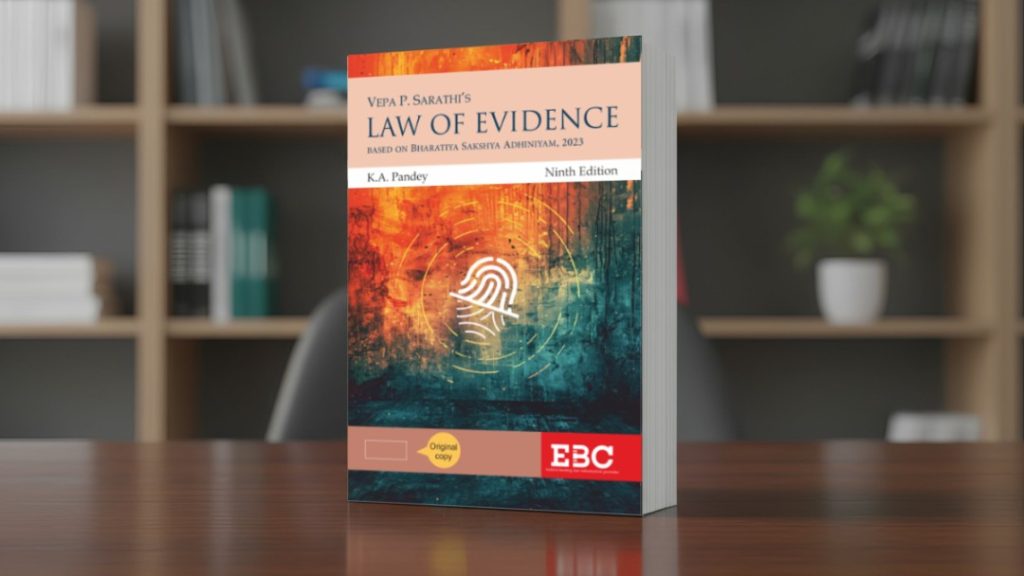
To know more about how Evidence Law works in India, you may check out this book.



10 Important BSA Sections Every Law Student Must Know In 2026
[…] 9. Section 104 — Burden of Proof […]