Arbitration in India is the preferred route for resolving commercial disputes without going through crowded civil courts. If you have ever signed a contract with an “arbitration clause,” you have already agreed to this process. This guide explains how arbitration in India actually works, which laws govern it, and the specific situations where Indian courts can still intervene.
What Is Arbitration and Why It Matters
Arbitration is a private method of dispute resolution where two or more parties agree to let a neutral third person, called an arbitrator, decide their dispute instead of a judge. The decision, called an “arbitral award,” is legally binding, much like a court judgment.
Businesses prefer arbitration in India because it is generally faster, confidential, and allows parties to choose an expert arbitrator familiar with their industry. Indian courts are supportive of arbitration in principle, but they retain specific powers to check the process, mainly to prevent fraud, protect public policy, or assist parties who cannot otherwise get relief.
The Governing Law: Arbitration and Conciliation Act, 1996
The primary statute is the Arbitration and Conciliation Act, 1996, based on the UNCITRAL Model Law on International Commercial Arbitration, a global template most countries use to keep their arbitration rules consistent. The Act has four parts:
- Part I covers domestic arbitration and arbitration seated in India.
- Part II deals with enforcement of foreign arbitral awards under the New York Convention and Geneva Convention.
- Part III covers conciliation, a related but separate process where a neutral conciliator helps parties reach a voluntary settlement rather than imposing a decision.
- Part IV contains supplementary provisions.
Since 1996, the Act has been amended several times to fix practical problems and reduce delays:
- Arbitration and Conciliation (Amendment) Act, 2015: Introduced strict timelines, limited court interference at the interim relief stage, and clarified when an arbitrator can be considered biased.
- Arbitration and Conciliation (Amendment) Act, 2019: Created the Arbitration Council of India to promote institutional arbitration and set qualification standards for arbitrators.
- Arbitration and Conciliation (Amendment) Act, 2021: Allowed courts to grant an unconditional stay on enforcement of an award if fraud or corruption is shown in how the arbitration agreement or award was obtained.
A Draft Arbitration and Conciliation (Amendment) Bill, 2024 is currently under public consultation. It proposes recognising emergency arbitrators (arbitrators appointed urgently before the full tribunal is formed, to grant immediate interim protection), creating an appellate arbitral tribunal for internal appeals, and removing conciliation provisions since the Mediation Act, 2023 now covers that separately. This remains a draft and is not yet law, so the 1996 Act as amended in 2015, 2019, and 2021 is still the operative framework.
Key Related Statutes
Several other laws interact with arbitration in India:
- The Mediation Act, 2023: Governs mediation, a voluntary settlement process, separately from arbitration, and encourages pre litigation mediation.
- The Code of Civil Procedure, 1908: Section 89 allows courts to refer disputes to arbitration or mediation even after a suit has begun.
- The Indian Contract Act, 1872: Since an arbitration clause is a contract, principles of a valid contract, such as free consent and lawful object, apply to arbitration agreements too.
- The Commercial Courts Act, 2015: Establishes specialised commercial courts that handle arbitration related applications for high value commercial disputes.
- The Foreign Exchange Management Act, 1999: Relevant where cross border arbitration awards involve payment in foreign currency.
How Arbitration Works: The Process
The table below outlines the typical stages under the Act.
| Stage | Governing Section | What Happens | Typical Timeline |
|---|---|---|---|
| Arbitration Agreement | Section 7 | Parties agree in writing to refer disputes to arbitration | At contract signing |
| Appointment of Arbitrator | Section 11 | Parties appoint an arbitrator; if they cannot agree, the High Court or Supreme Court appoints one | Court must decide within 60 days of application |
| Interim Relief | Section 9 | Either party can approach a court for urgent protective orders before or during arbitration | As urgent as the case requires |
| Tribunal’s Interim Powers | Section 17 | The arbitral tribunal itself can grant interim measures once constituted | During proceedings |
| Statement of Claim and Defence | Section 23 | Parties formally present their case and evidence | As fixed by tribunal |
| Award | Section 29A | Tribunal must render its final award | Within 12 months of completion of pleadings, extendable by 6 months by consent |
| Challenge to Award | Section 34 | A party can ask the court to set aside the award on limited grounds | Within 3 months of receiving the award, plus 30 days condonable delay |
| Enforcement | Section 36 | If not challenged or the challenge fails, the award is enforced like a court decree | After challenge period lapses |
Rights and Obligations of Parties
| Rights | Obligations |
|---|---|
| Choose the arbitrator, seat, and procedural rules | Act in good faith and disclose relevant facts |
| Seek interim protection from courts or the tribunal | Participate in proceedings within given timelines |
| Present evidence and cross examine | Bear costs as allocated, usually on a “loser pays” basis |
| Challenge an award on limited statutory grounds | Comply with the award once it becomes enforceable |
| Appeal certain orders under Section 37 | Not misuse court processes to delay arbitration |
When Courts Step In: Judicial Intervention
Indian arbitration law is built on a “minimal interference” principle under Section 5, meaning courts should not intervene except where the Act specifically allows it. The main entry points for court involvement are:
- Before arbitration begins: Under Section 8, a court hearing a civil suit must refer parties to arbitration if a valid arbitration agreement exists and one party objects to the suit proceeding.
- Appointing an arbitrator: Under Section 11, if parties cannot agree on who the arbitrator should be, the High Court or Supreme Court steps in to appoint one.
- Granting interim relief: Under Section 9, courts can freeze assets, protect goods, or issue similar orders before an arbitral tribunal is even formed.
- Setting aside an award: Under Section 34, a court can set aside an award only on narrow grounds such as incapacity of a party, invalid arbitration agreement, lack of proper notice, the award dealing with matters outside the arbitration agreement, improper composition of the tribunal, or the award conflicting with the public policy of India.
- Enforcement disputes: Under Section 36, courts handle objections to enforcing a domestic or foreign award, including whether a stay on enforcement should be granted.
- Appeals: Under Section 37, specific orders, such as refusal to refer parties to arbitration or grant of interim relief, can be appealed to a higher court.
Courts cannot review the merits of the arbitrator’s decision. They cannot reassess evidence or substitute their own view for the arbitrator’s findings. This is what keeps arbitration faster than full blown litigation.
Grounds for Setting Aside or Refusing Enforcement of an Award
| Ground | Applies To |
|---|---|
| Party under incapacity or invalid agreement | Section 34(2)(a) |
| No proper notice of appointment or proceedings | Section 34(2)(a) |
| Award deals with disputes not covered by the agreement | Section 34(2)(a) |
| Composition of tribunal not per agreement | Section 34(2)(a) |
| Subject matter not arbitrable under Indian law | Section 34(2)(b) |
| Award conflicts with public policy of India, including fraud or corruption | Section 34(2)(b) |
| Foreign award unenforceable per New York Convention grounds | Section 48 |
Penalties and Remedies
The Act itself does not impose criminal penalties, since arbitration is a civil, contractual mechanism. However, remedies and consequences include:
- Cost awards: Under Section 31A, the tribunal decides who bears the costs, generally following the principle that costs follow the outcome.
- Interest: Under Section 31, the tribunal can award interest on the sum due, both during the arbitration and after the award until payment.
- Contempt-like consequences: If a party disobeys an interim order under Section 17, it is deemed to be an order of the court and can be enforced in the same manner as a court order, including through execution proceedings.
- Enforcement as a decree: Once final, the award is enforced exactly like a civil court decree, meaning the winning party can attach property or pursue similar execution remedies.
Frequently Asked Questions
The Arbitration and Conciliation Act, 1996, as amended in 2015, 2019, and 2021, is the primary law governing arbitration in India.
No. Certain matters are considered non arbitrable under Indian law, such as criminal matters, matrimonial disputes, insolvency proceedings, and certain tenancy matters governed by rent control legislation.
Under Section 29A, the tribunal must generally pass its award within 12 months from completion of pleadings, extendable by 6 months with party consent, and beyond that only with court approval.
No. Courts can only set aside an award on the limited grounds listed in Section 34; they cannot rewrite or modify the award’s substance.
The other party can approach the High Court, or the Supreme Court for international commercial arbitration, under Section 11 to have an arbitrator appointed.
Further Reading for Legal Students & Practitioners
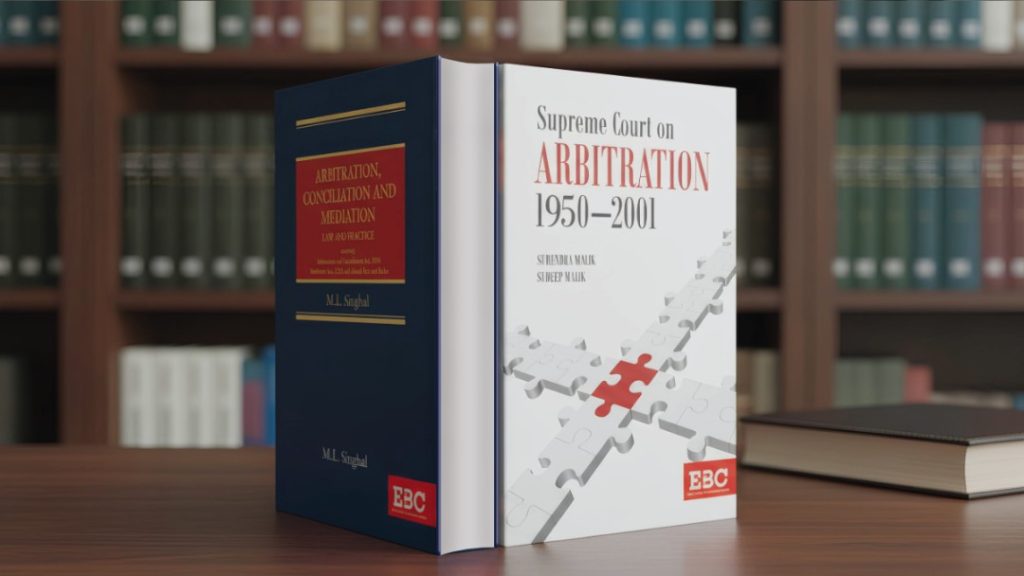
- For deep case-law insight into how India’s top court handles arbitration Supreme Court on Arbitration by Surendra Malik & Sudeep Malik provides an authoritative collection of landmark judgments, trends, and doctrinal developments.
- For a practical guide to arbitration, conciliation, and mediation in Indian and international contexts, Arbitration, Conciliation & Mediation: Law & Practice by M.L. Singhal offers structured explanations, procedural guidance, and comparisons across dispute-resolution mechanisms.