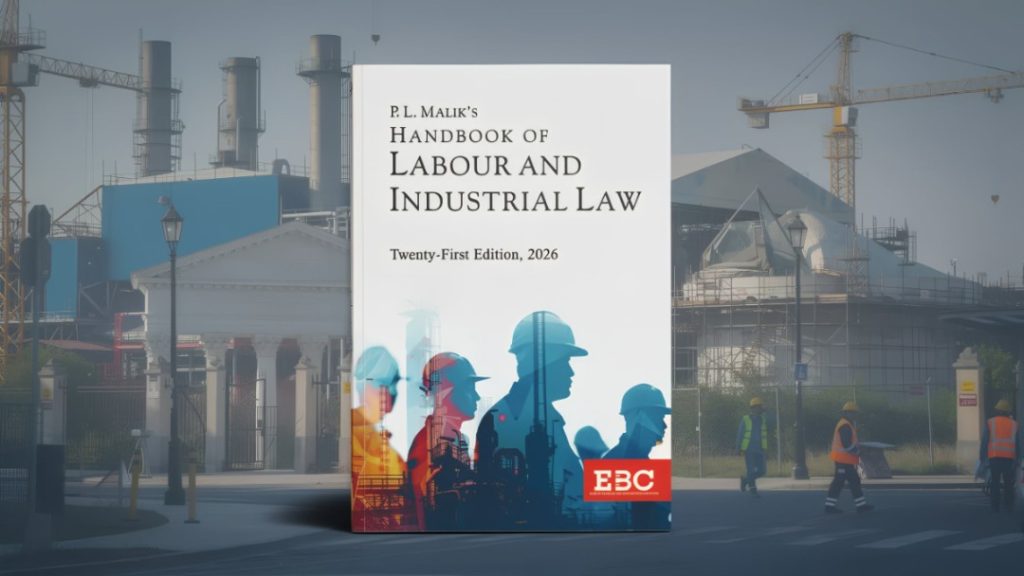
Indian labour law is currently undergoing its most significant structural transformation in decades. With the consolidation of numerous labour statutes into four comprehensive Labour Codes, understanding both the legacy framework and the new legal regime has become essential for practitioners and students alike.
P. L. Malik’s Handbook of Labour and Industrial Law (21st Edition) serves as a consolidated and updated reference that reflects this transition in Indian labour and industrial law.
The Shift to the Four Labour Codes
The 21st Edition of the Handbook has been thoroughly revised to incorporate the four Labour Codes enforced on 2 November 2025, namely:
- Code on Wages, 2019
- Code on Social Security, 2020
- Industrial Relations Code, 2020
- Occupational Safety, Health and Working Conditions Code, 2020
These Codes replace a large number of earlier labour enactments and aim to simplify, consolidate, and rationalise labour regulation in India. The Handbook reflects this shift by restructuring its content to align with the new statutory framework while retaining references to repealed legislation where relevant.
Comparative Mapping of Repealed Acts and New Provisions
A key feature of the 21st Edition is the detailed comparative table that maps repealed Acts to corresponding provisions under the Labour Codes. This allows readers to:
- Trace how rights and obligations under earlier laws have been carried forward
- Understand continuity and change in legislative intent
- Navigate the transition from the old regime to the new Codes with clarity
Such comparative analysis is particularly useful for practitioners dealing with legacy disputes or transitional compliance issues.
Section-Wise Cross-Referencing for Legal Clarity
The Handbook adopts a unique section-wise cross-referencing approach, where references to repealed laws are provided below each relevant section, sub-section, and clause of the Labour Codes. This method:
- Helps readers immediately identify the source law
- Assists in interpreting new provisions in light of prior judicial understanding
- Reduces ambiguity when comparing old and new legal positions
This structural feature enhances the usability of the book as a working reference.
Coverage of Amendments and Judicial Decisions
The 21st Edition reflects the latest amendments to unrepealed labour laws and incorporates important decisions of the Supreme Court and various High Courts. Case law is placed under relevant statutory provisions, enabling readers to:
- Understand how courts have interpreted labour statutes
- Connect legislative text with judicial application
- Stay updated on evolving legal principles in labour and industrial law
This integration of statute and case law makes the Handbook both descriptive and interpretative.
Inclusion of State Amendments and Supporting Materials
Recognising the federal structure of labour regulation in India, the Handbook includes State amendments at appropriate places. In addition, it provides:
- Explanatory notes
- Statements of Objects and Reasons
- Enforcement dates of statutes and provisions
These elements support practical application and contextual understanding, particularly for compliance professionals and advisors.