A Classic Work in Indian Legal Education
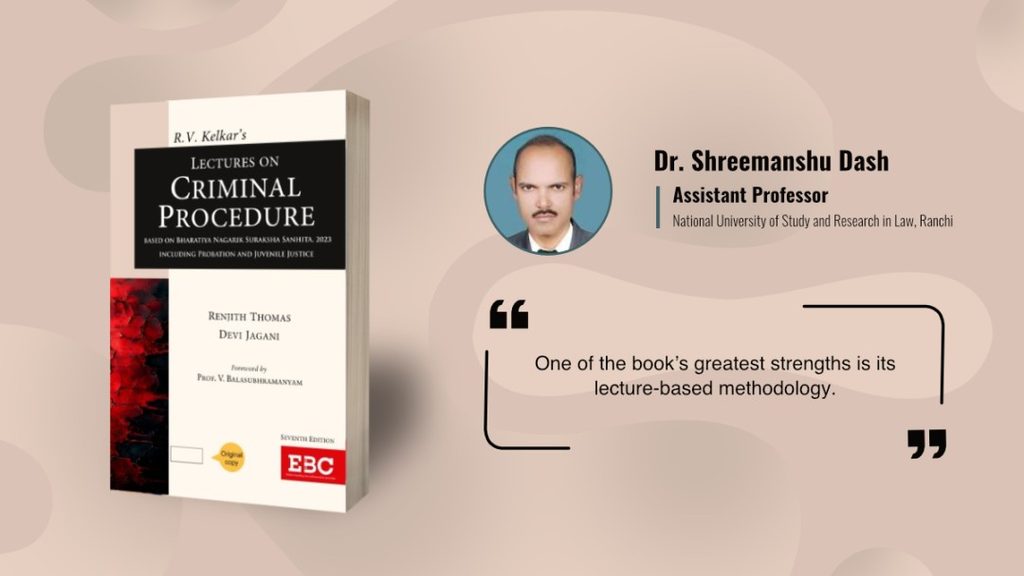
R.V. Kelkar’s Lectures on Criminal Procedure occupies a distinctive place in Indian legal education. Originally conceived as a lucid exposition of criminal procedural law, the work has acquired enduring academic value because of its systematic organization and accessible treatment of complex procedural principles. The seventh edition, revised by Renjith Thomas and Devi Jagani and published by Eastern Book Company in 2025, represents an important transformation of the classic work. It comprehensively adapts the text to the Bharatiya Nagarik Suraksha Sanhita, 2023 (BNSS), while retaining the pedagogical character associated with Kelkar’s original lectures. The edition is also notable for its dedicated treatment of probation and juvenile justice.
Understanding the Transition from Cr.P.C. to BNSS
The significance of this edition lies primarily in its timing. Indian criminal procedure has entered a new legislative phase with the replacement of the Code of Criminal Procedure, 1973 by the BNSS. For students and teachers accustomed to the Cr.P.C. framework, the transition requires more than merely replacing section numbers. It requires an understanding of the philosophy, structure and procedural consequences of the new legislation. The present edition responds to this need by restructuring the traditional treatment of criminal procedure around the BNSS.
A Distinctive Lecture-Based Methodology
One of the book’s greatest strengths is its lecture-based methodology. Instead of presenting criminal procedure as an enormous collection of statutory provisions, the authors divide the subject into twenty-two logically arranged lectures. The progression begins with preliminary considerations and functionaries under the BNSS and moves through arrest, search and seizure,
investigation, jurisdiction, cognizance, bail, fair trial, charges and different forms of trial. It subsequently addresses judgments, appeals, revision, execution of sentences, preventive proceedings, maintenance, juvenile justice and probation. This arrangement makes the procedural journey of a criminal case comparatively easy to follow.
Arrest, Investigation and Bail
The treatment of arrest, investigation and bail is particularly important because these areas lie at the intersection of individual liberty and the powers of the State. A sound understanding of criminal procedure requires students to appreciate not merely what the police and courts are empowered to do, but also why procedural safeguards exist. By placing these subjects within the broader architecture of fair trial and criminal justice, the book facilitates a more principled understanding of procedural law.
The Importance of Fair Trial
Another commendable feature is the book’s attention to fair trial principles. Criminal procedure is ultimately concerned with balancing competing interests: the interests of the victim, the accused, the investigating agency, the prosecution and society at large. The inclusion of a separate lecture on the principal features of a fair trial helps prevent the subject from becoming a purely technical exercise in statutory interpretation. It reminds the reader that procedural rules are instruments for achieving justice and protecting constitutional values.
Understanding Different Forms of Criminal Trials
The book also demonstrates considerable pedagogical value through its treatment of different forms of criminal trials. Separate lectures deal with warrant cases, summons cases and summary trials, while another addresses the disposal of criminal cases without a full trial. This classification allows students to appreciate the procedural differences arising from the nature and gravity of offences and to understand why criminal adjudication cannot be reduced to a single uniform model.
Juvenile Justice and Probation
The inclusion of juvenile justice and probation is another significant strength. Criminal justice is not exclusively about punishment; it also involves rehabilitation, reform and social reintegration. The separate treatment of juvenile justice and probation brings these reformative dimensions into the study of criminal procedure. This makes the book particularly useful for contemporary legal education, where the relationship between punishment, rehabilitation and restorative approaches has acquired increasing importance.
Recent Judicial and Procedural Developments
The revised edition also benefits from its effort to incorporate recent judicial developments and contemporary procedural issues. The publisher’s description highlights updated case law, exercises for conceptual clarity, technological developments in procedure, plea-bargaining reforms and safeguards relating to arrest. Such features enhance the book’s usefulness beyond conventional examination preparation and make it relevant to students, academics, judicial service aspirants and practitioners.
Bridging Theory and Practical Utility
A further merit is the balance between conceptual explanation and practical utility. Criminal procedure is a subject in which students frequently struggle to connect statutory provisions with the actual stages of a criminal case. The lecture format helps bridge this gap. The sequence from arrest and investigation to cognizance, bail, trial, judgment and appeal enables readers to visualize criminal proceedings as a continuous process rather than as disconnected legal topics.
Limitations and Scope for Further Reference
Nevertheless, the book is not without limitations. The transition from CrPC to BNSS is accompanied by several interpretative questions, and some provisions of the new procedural framework will inevitably require further judicial clarification. A textbook published at this stage can therefore provide only a snapshot of a developing legal regime. Students and practitioners should supplement the book with the latest Supreme Court and High Court decisions, statutory amendments, rules and authoritative governmental materials. Moreover, readers seeking an exhaustive practitioner-oriented commentary may require a more detailed section-by-section reference work alongside this text.
Carrying Forward Kelkar’s Legacy
Overall, the seventh edition of R.V. Kelkar’s Lectures on Criminal Procedure is a timely and valuable contribution to the study of India’s new criminal procedural law. Its greatest achievement is that it preserves the clarity and educational orientation of Kelkar’s classic work while adapting it to the BNSS, 2023. The revisions by Renjith Thomas and Devi Jagani successfully address the immediate needs created by the transition to the new criminal-law regime. The book’s systematic structure, lecture-based presentation, treatment of fair trial, arrest, investigation, bail and trial, together with its incorporation of juvenile justice and probation, makes it particularly suitable for contemporary legal education.
For LL.B. and LL.M. students, law teachers, judicial-service aspirants, researchers and practitioners, the book can serve as a strong foundational text on criminal procedure under the BNSS. More importantly, it encourages the reader to see criminal procedure not simply as a collection of procedural commands, but as a framework designed to reconcile the powers of the State with the rights and dignity of individuals. In that respect, the seventh edition succeeds in carrying the intellectual legacy of R. V. Kelkar into the era of India’s new criminal laws.
Want the deeper dive? Grab the reference book.