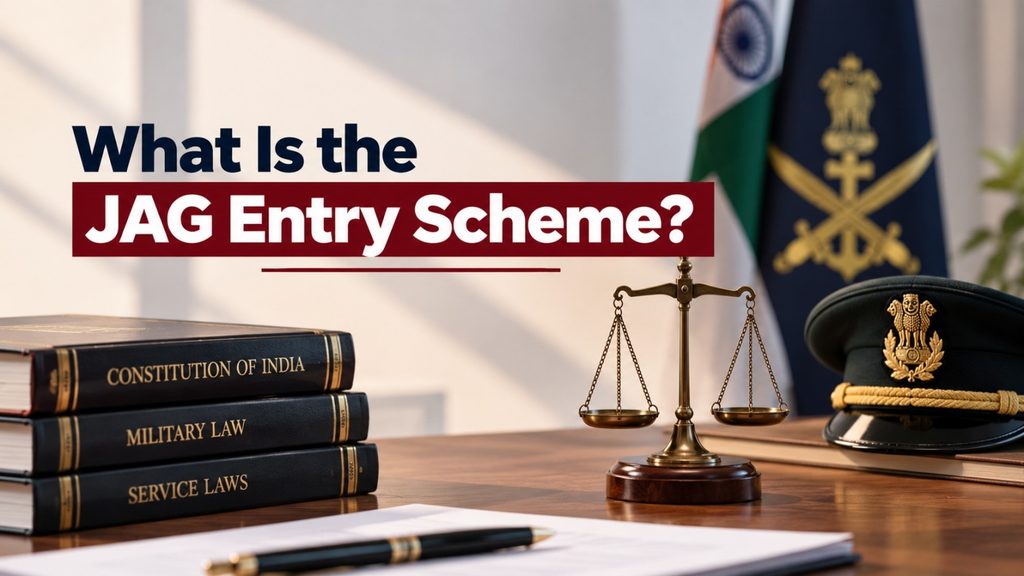
The JAG Entry Scheme is the route through which the Indian Army commissions law graduates as officers in its Judge Advocate General (JAG) Branch, the army’s own legal wing. If you are a law student wondering what an Indian Army law officer actually does, this guide explains the role, JAG eligibility, selection, training, pay and the laws behind the job.
What Is the JAG Entry Scheme?
Under the scheme, law graduates join on a Short Service Commission (SSC), a fixed-term officer commission of 10 years that can be extended by up to 4 years. A Permanent Commission, which means service until retirement, may be offered after 10 years, subject to vacancies and suitability. Seats are very limited: 8 in the 124th course and 10 in the 125th course, shared between men and women.
Laws Behind the Judge Advocate General Branch
Every Indian Army law officer works within these laws:
- Constitution of India, Article 33: allows Parliament to restrict the fundamental rights of armed forces members to preserve discipline.
- Army Act, 1950: the main law on military offences, punishments and courts-martial (military trials). Section 69 treats civil offences by soldiers as army offences, and Section 125 decides whether a civil court or a court-martial tries the case.
- Army Rules, 1954: the procedure for hearing charges, recording evidence and conducting trials.
- Armed Forces Tribunal Act, 2007: created the Armed Forces Tribunal, which hears service disputes and court-martial appeals.
- Advocates Act, 1961: governs enrolment as an advocate, which applicants must be eligible for.
- Bharatiya Nyaya Sanhita, Bharatiya Nagarik Suraksha Sanhita and Bharatiya Sakshya Adhiniyam, 2023: these replaced the IPC, CrPC and Evidence Act from 1 July 2024, so JAG officers now apply them to civil offences tried under the Army Act.
Role and Duties of an Indian Army Law Officer
Life as a JAG officer mixes desk work, courtroom work and field exposure. Typical duties include:
- Advising commanders on the Army Act, service rules and discipline.
- Acting as judge advocate under Section 129, guiding a court-martial on points of law.
- Assisting in prosecutions and vetting charges before they are framed.
- Drafting replies in High Court, Supreme Court and Armed Forces Tribunal cases.
- Advising on contracts, land, operational law and international humanitarian law (rules protecting people during war).
Court-Martial Types at a Glance
| Court | Composition | Maximum punishment |
|---|---|---|
| General Court Martial | Senior officers with a judge advocate | Any punishment under the Act, including death |
| District Court Martial | Officers | Up to 2 years imprisonment |
| Summary Court Martial | Commanding officer | Up to 1 year imprisonment |
Section 120 limits the powers of the lower courts. For remedies, an accused may petition under Section 164 against a finding or sentence, then approach the Armed Forces Tribunal, and finally the Supreme Court.
JAG Eligibility at a Glance
| Criterion | Requirement |
|---|---|
| Degree | LLB (3-year or 5-year) with at least 55% aggregate |
| Enrolment | Eligible to enrol with a Bar Council |
| Age | 21 to 27 years on the date given in the notification |
| Marital status | Unmarried |
| Citizenship | Indian citizen |
| Entrance score | CLAT PG score, used for shortlisting |
How the Selection Process Works
Online application
   -> CLAT PG shortlisting
   -> SSB interview (5 days)
   -> Medical test
   -> Merit list
   -> Training at OTA Chennai (49 weeks)
   -> Commission as Lieutenant
The SSB (Services Selection Board) tests personality, communication and officer-like qualities, not legal knowledge. There is no separate written exam, and applications are made online at joinindianarmy.nic.in. Courses are notified about twice a year.
Pay, Rank and Career
Officers start as Lieutenants in Pay Level 10, with basic pay of Rs 56,100 to Rs 1,77,500 per month plus allowances. Promotion to Captain and Major follows with years of service. After leaving, many officers move into corporate legal roles or private practice.
FAQs
No. Applications are shortlisted on CLAT PG score, followed by the SSB interview.
No. Only unmarried men and women are eligible.
You must be eligible to enrol under the Advocates Act and meet the condition stated in the notification.
Their role is mainly legal, but as army officers they may be posted to field areas.
No. It depends on vacancies, performance and suitability.