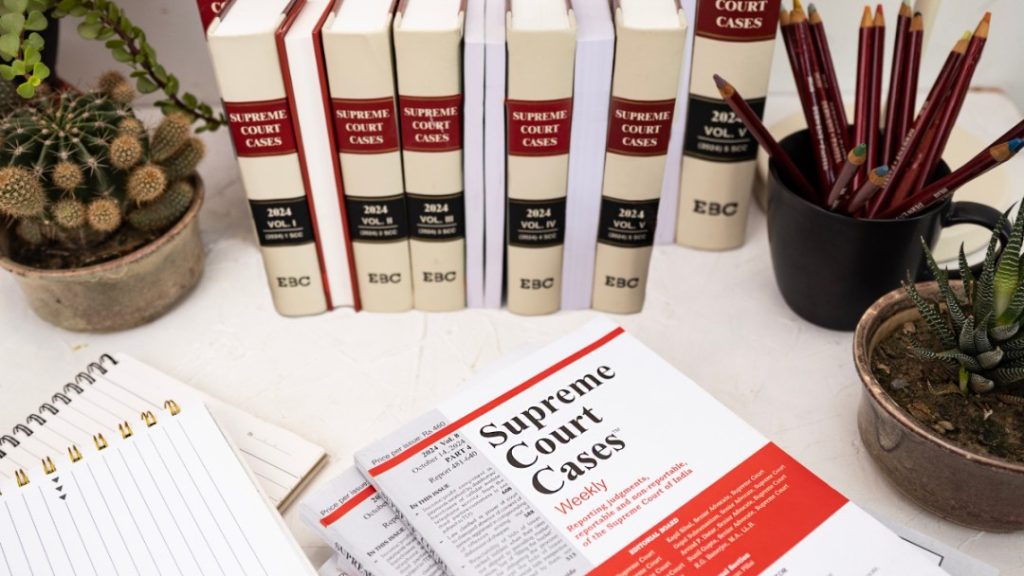
Supreme Court Cases (SCC) is India’s most trusted and authoritative law reporting journal, relied upon daily by judges, advocates, and legal scholars. It delivers accurate, well-edited Supreme Court judgments with expertly crafted headnotes and footnotes. For generations of legal professionals, SCC has been the gold standard of legal research and courtroom preparation.
Step 1: How to Find the Case in SCC Weekly
When you pick up an SCC Weekly part (one issue of the journal), don’t start reading from page 1.
First, open the beginning pages. You will usually find:
- Table of Cases Reported
- This is a list of all cases reported in that Weekly part.
- The cases are usually in alphabetical order (A to Z).
- Next to each case, you will see the page number where that case starts.
- Subject Index (sometimes in the beginning, sometimes later)
- This is arranged by topic, like:
- Insolvency Law
- Constitution
- Motor Vehicles
- Under each topic, you see case details and page numbers.
- This is arranged by topic, like:
How to make the best of SCC (Print)
- If you know the case name
→ Go to Table of Cases, find the name, note the page number, and go to that page. - If you know only the topic (like “bail” or “Article 21”)
→ Go to Subject Index, find your topic, see the list of cases and pages, and then choose the most relevant one. - If you know the SCC citation (for example: (2025) 3 SCC 100)
that means, you can find the same case in 2025’s Volume 3 and on page number 100 according to the above example
Step 2: How to Read a Case Law/ Judgement
Once you open the page where your case starts, you will see many things. Let’s break them into pieces.
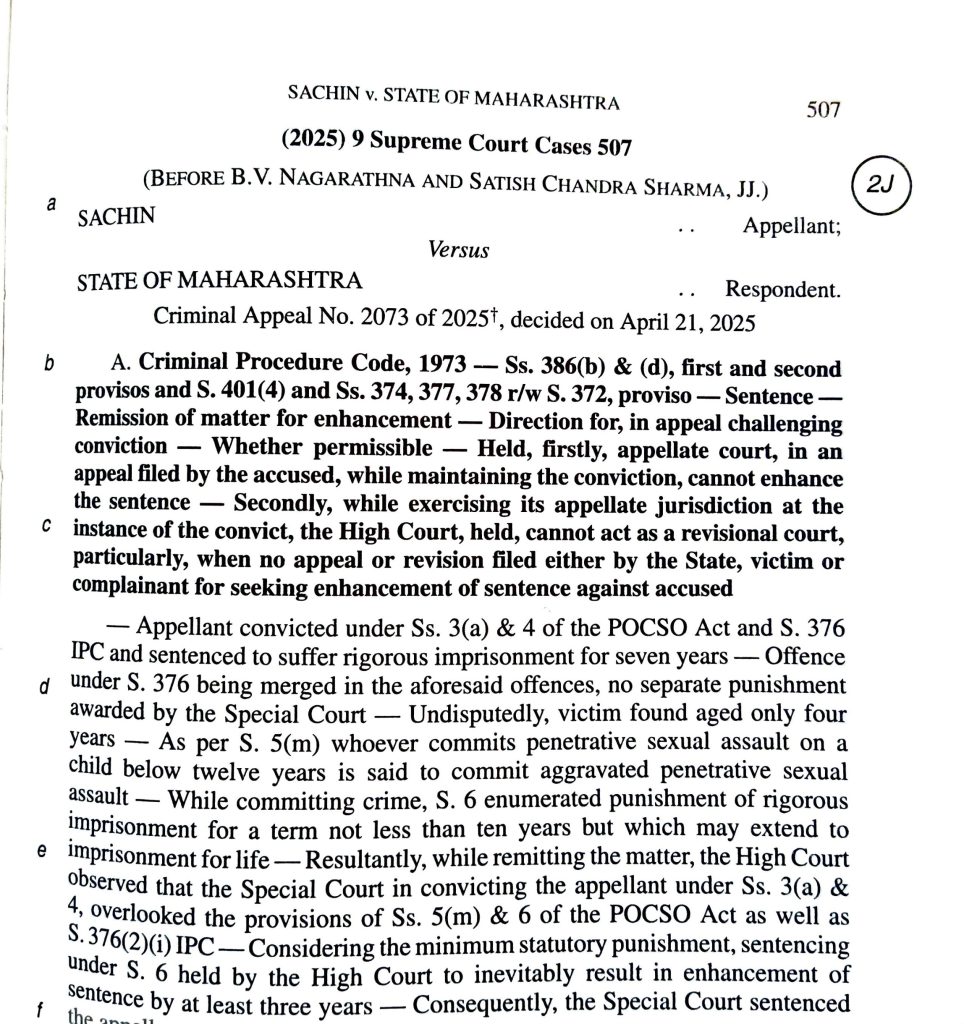
- Case Title (Names of the Parties)
Example:
Sachin v. State Of Maharashtra - Citation Line at the Top
Example : (2025) 9 Supreme Court Cases 507
This tells you which book and page this case belongs to. - Details about the judges: for example –
- Date
- this portion will inform about the date of the decision, like:
“Decided on: April 21, 2025”
- this portion will inform about the date of the decision, like:
- Bench
- On the top right of the page you will see the number of the judges
- In the above image : 2J
- Judgment Text
- After the headnote, the actual judgment begins.
Step 3: Understanding the Headnote
- The Headnote is the “Shortcut to the Judgment’s Soul”
The headnote in Supreme Court Cases (SCC) captures the entire essence of a long judgment in a few powerful lines, the facts, the legal issue, the reasoning, and the final ruling. In a profession where time is everything, the headnote allows a lawyer to understand the core of a case in minutes instead of hours, making it the fastest gateway to judicial wisdom.
- The Headnote Transforms Complex Law into Usable Knowledge
Judgments are written for courts, but headnotes are written for users of law—lawyers, students, and judges. By converting dense judicial language into clear, structured legal propositions, the headnote turns a judgment from a difficult document into a ready-to-use legal tool, making it invaluable for quick research, drafting, and courtroom arguments.
Step 4: What Are A, B, C, D on the Left Side?
In SCC Weekly, you’ll often see letters like a, b, c, d printed in the left margin next to parts of the headnote or judgment.
Very simple:
- Each letter (A, B, C, etc.) marks one main point of law or one important part.
- For example:
- (2025) 9 Supreme Court Cases 507- c
So, think of A, B, C, D as labels for different important legal ideas in that case.
Step 5: Significance of the Footnote:

- SCC footnotes show the life of a case—whether it is followed, distinguished, or overruled—protecting you from citing bad law.
- SCC footnotes connect one judgment to many others, turning a single case into a complete research trail in seconds.
Step 5: Special Things About SCC Weekly
- Multi-User Access: SCC volumes can be accessed by you and your juniors simultaneously, ensuring uninterrupted research and learning for the entire team.
- Most Cited: SCC is the most widely cited law report in renowned legal commentaries and authoritative textbooks.
- No Distractions / Better Retention: Reading from print ensures higher focus and superior information retention compared to digital reading.
- Collectability / Aesthetics: A well-maintained set of SCC volumes is the pride of every advocate’s library and a symbol of professional excellence.
- Tax Savings: Investment in SCC appreciates over time and is tax-deductible, making it not just a resource but a sound financial investment.
Step 6: How to Practically use SCC
- Make Your Own Handwritten Case Notes
- Highlight Only What Truly Matters
- Use Sticky Notes and Page Flags
- Take photocopies of important judgments
- Maintain Subject-Wise Folders (Physical or Digital)
- Write Margin Notes in Simple Words
- Compare Old and New SCC Judgments