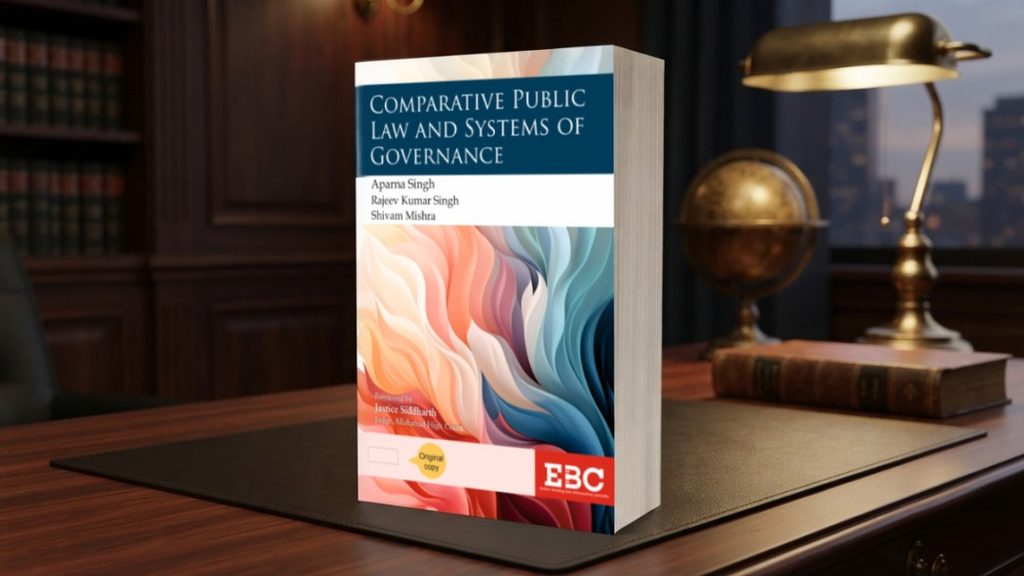
Comparative Public Law examines how different countries structure government, protect rights, distribute public power, and maintain constitutional accountability. In India, comparative public law is particularly relevant because the Constitution of India combines parliamentary government, federalism, fundamental rights, judicial review, and independent constitutional institutions. Studying these features alongside other constitutional systems helps explain how Indian public law responds to questions of governance, liberty, equality, and institutional power.
What Is Comparative Public Law?
Comparative public law involves examining the constitutional and administrative systems of different jurisdictions to identify similarities, differences, and evolving approaches. It covers constitutionalism, the principle that government power must operate within constitutional limits, as well as separation of powers, fundamental rights, federalism, judicial review, and administrative accountability.
In India, the principal source is the Constitution of India, which establishes the Union and State governments, defines their powers, guarantees fundamental rights, and provides mechanisms for constitutional remedies.
Constitutionalism and the Structure of Government
The Constitution establishes India as a sovereign, socialist, secular, democratic republic with a parliamentary system. Articles 52 to 78 establish the Union executive, including the President and Council of Ministers, while Articles 79 to 122 establish Parliament.
The Constitution also distributes legislative powers between the Union and States. Article 246, read with the Seventh Schedule, divides subjects into the Union List, State List, and Concurrent List. This division is central to Indian federalism.
Key constitutional principles
| Principle | Indian constitutional framework | Purpose |
| Separation of powers | Executive, legislature and judiciary | Prevents concentration of public power |
| Federalism | Articles 245 to 263 and Seventh Schedule | Divides powers between Union and States |
| Fundamental rights | Articles 12 to 35 | Protects individual liberties |
| Judicial review | Articles 32 and 226 | Enables constitutional remedies |
| Constitutional amendment | Article 368 | Provides a formal amendment process |
Fundamental Rights and Constitutional Governance
Part III of the Constitution protects fundamental rights. Article 14 guarantees equality before law and equal protection of laws. Article 19 protects specified freedoms, subject to constitutionally permitted restrictions. Article 21 protects life and personal liberty.
Other important protections include Articles 15 and 16 concerning equality and non-discrimination, Article 20 concerning protection in criminal matters, Article 22 concerning safeguards against arrest and detention, and Articles 25 to 28 concerning freedom of religion.
These provisions demonstrate an important feature of comparative public law: constitutional government is not only about creating institutions but also about limiting their power.
Judicial Review and Constitutional Remedies
Judicial review means the authority of constitutional courts to examine whether governmental action complies with the Constitution.
Article 32 provides a constitutional remedy before the Supreme Court for enforcement of fundamental rights. Article 226 gives High Courts wider writ jurisdiction, including in appropriate cases involving legal rights beyond fundamental rights.
The principal writs are:
- Habeas corpus: protection against unlawful detention.
- Mandamus: directs a public authority to perform a legal duty.
- Certiorari: permits judicial review of specified decisions of lower courts or tribunals.
- Prohibition: restrains a lower court or tribunal from exceeding its jurisdiction.
- Quo warranto: questions a person’s legal authority to hold a public office.
Constitutional Amendments and Democratic Change
Article 368 provides the principal constitutional framework for amendment. Depending on the provision involved, an amendment may require a special majority in Parliament and, for specified federal matters, ratification by at least half of the State Legislatures.
The Constitution (One Hundred and Sixth Amendment) Act, 2023 is a significant recent constitutional development. It introduced provisions concerning reservation of seats for women in the Lok Sabha and State Legislative Assemblies through Articles 330A and 332A, together with Article 334A concerning when those provisions take effect.
Comparative Public Law and Governance
Comparative public law also examines administrative institutions and accountability. In India, public administration operates through constitutional principles, legislation, delegated legislation, and regulatory institutions.
The Right to Information Act, 2005 strengthens governmental transparency by providing citizens with a statutory mechanism for obtaining information from public authorities, subject to specified exemptions. The Administrative Tribunals Act, 1985 provides for adjudication of specified service-related disputes through administrative tribunals.
Environmental governance, digital administration, electoral regulation, and public accountability increasingly demonstrate how constitutional principles interact with specialised legislation.
FAQs
It is the study and comparison of constitutional and public-law systems across different countries.
It helps students and researchers understand India’s constitutional institutions by comparing them with alternative systems of government and rights protection.
The Constitution of India is the principal source, supplemented by legislation, rules, regulations, and constitutional institutions.
Judicial review is the constitutional process through which courts examine governmental action for conformity with constitutional and legal requirements.
Fundamental rights are constitutionally protected rights contained primarily in Part III, including equality, specified freedoms, religious freedom, and protection of life and personal liberty.
Want the deeper dive? Grab the reference book.