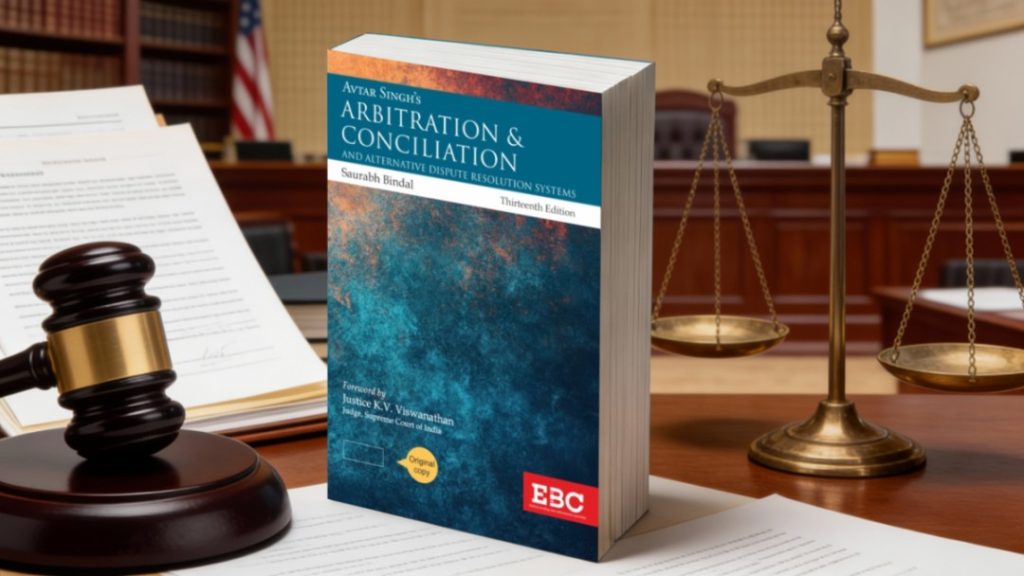
Arbitration has become one of the most important methods of resolving commercial disputes in India. With courts encouraging faster and more efficient dispute resolution, arbitration law has evolved rapidly, both through legislative amendments and landmark judicial decisions. In this changing legal landscape, Avtar Singh’s Law of Arbitration and Conciliation continues to remain one of the most trusted and authoritative texts on the subject.
This blog explains the purpose, scope, and significance of the latest edition of the book in a clear, reader-friendly manner.
What Is Avtar Singh’s Law of Arbitration and Conciliation About?
The current edition of Avtar Singh’s Law of Arbitration and Conciliation provides a comprehensive and updated analysis of arbitration law in India. It covers the entire framework of the Arbitration and Conciliation Act, 1996, while also tracing the historical development of arbitration from the Arbitration Act, 1940 to the modern pro-arbitration regime.
The book explains not only what the law is, but why it has evolved the way it has, making it especially useful for students, lawyers, judges, arbitrators, and academics.
Coverage of Key Amendments and Reforms
One of the strongest features of this edition is its detailed treatment of the 2015, 2019, and 2021 amendments to the Arbitration and Conciliation Act, 1996. These amendments significantly reshaped Indian arbitration by:
- Reducing excessive court intervention
- Introducing stricter timelines for arbitral proceedings
- Strengthening institutional arbitration
- Clarifying enforceability of arbitral awards
- Aligning Indian arbitration law with international best practices
The book captures the spirit and objective behind these reforms, making complex statutory changes easy to understand.
Incorporation of Landmark Supreme Court Judgments
The updated edition reflects the latest judicial thinking of the Supreme Court of India, incorporating and analysing major recent decisions, including:
- Gayatri Balasamy v. ISG Novasoft Technologies Ltd. (2025) 7 SCC 1
- SBI General Insurance Co. Ltd. v. Krish Spg. (2024) 12 SCC 1
- Cox & Kings Ltd. v. SAP India (P) Ltd. (2024) 4 SCC 1
These judgments have shaped crucial areas such as:
- The scope of arbitration agreements
- The “group of companies” doctrine
- Party autonomy
- Court interference at the referral and enforcement stages
By explaining these rulings in a structured and analytical manner, the book bridges the gap between theory and real-world practice.
Authorship and Editorial Strength
The book builds on chapters originally authored by Dr Avtar Singh, preserving his trademark analytical depth and clarity. At the same time, it integrates modern perspectives to address contemporary arbitration challenges.
The current edition is enriched by contributions from leading arbitration practitioners:
- Saurabh Bindal, Advocate practising before the Supreme Court of India and Delhi High Court, with extensive experience in litigation and dispute resolution, and a strong academic background in law and engineering.
- R.V. Prabhat, Advocate-on-Record at the Supreme Court of India, specialising in commercial and construction arbitration, insolvency law, and constitutional law, with hands-on experience in high-stakes domestic and international arbitrations.
Their combined academic insight and courtroom experience make the book practically relevant and professionally reliable.