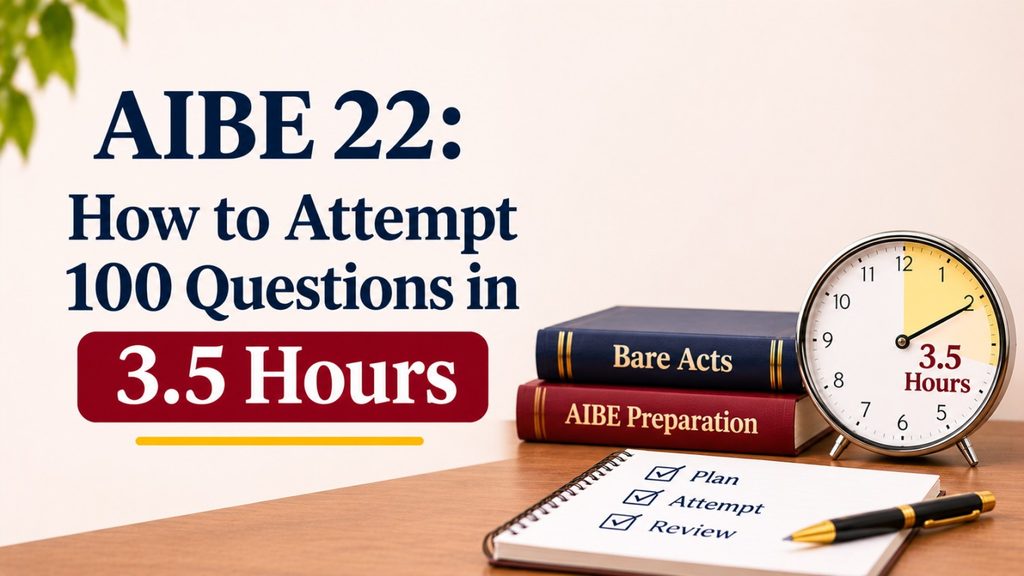
Mastering a smart AIBE 22 exam strategy is crucial for converting 210 minutes of test time into a passing score. Conducted by the Bar Council of India (BCI), the All India Bar Examination XXII (AIBE 22) tests 100 multiple-choice questions across 19 core legal subjects in an offline, pen-and-paper format. With an average of 2.1 minutes per question and zero negative marking, candidates must balance statutory accuracy, Bare Act lookup efficiency, and strict compliance with Bar Council regulations.
Statutory Framework Governing AIBE 22
The AIBE is not merely an academic test; it is a mandatory statutory qualification required to practice law in Indian courts. Its administration rests on specific provisions of Indian law:
- The Advocates Act, 1961 (Section 24 and Section 49(1)(ah)): Section 24 sets out the qualifications for admission as an advocate on a State Bar Council roll, while Section 49(1)(ah) empowers the BCI to prescribe conditions under which an advocate shall have the right to practice.
- Bar Council of India Rules (Part VI, Chapter III, Rules 9 to 11): Inserted via the All India Bar Examination Rules, 2010, Rule 9 mandates that no advocate graduating from the 2009-2010 academic year onward can practice under Chapter IV of the Advocates Act without passing the AIBE. Rule 10 grants the BCI authority to set the syllabus, exam rules, and passing criteria, while Rule 11 governs the issuance of the Certificate of Practice.
- The Bharatiya Nyaya Sanhita, 2023 (BNS), Bharatiya Nagarik Suraksha Sanhita, 2023 (BNSS), and Bharatiya Sakshya Adhiniyam, 2023 (BSA): Following recent criminal law reforms, AIBE 22 tests candidates on both the new criminal codes and the legacy statutes (IPC, CrPC, and Indian Evidence Act).
- The Rights of Persons with Disabilities Act, 2016 (Section 17): Entitles eligible benchmark disability candidates to compensatory time of 20 minutes per hour, extending their total exam duration by 70 minutes.
Subject Weightage and Time Allocation Plan
Under the official syllabus, 19 legal subjects carry varied weightages. High-yield subjects account for more than half of the total 100 marks.
| Subject Category | Question Weightage | Recommended Time Slot | Core Strategy |
| Criminal Law (IPC/BNS, CrPC/BNSS, Evidence/BSA) | 26 Questions | 55 Minutes | Focus on section numbers, arrest rules, and burden of proof |
| Constitutional Law & Administrative Law | 13 Questions | 25 Minutes | Prioritize Fundamental Rights, Writs, and Constitutional Articles |
| Civil Procedure (CPC) & Contract/Property/NI Act | 18 Questions | 40 Minutes | Use Bare Act indexes for Orders, Rules, and specific remedies |
| Family Law, Tort, Consumer & Motor Vehicles | 13 Questions | 25 Minutes | Rely on conceptual recall and statutory definitions |
| Ethics, ADR, Labour, Taxation, Cyber, IP, IPR & Others | 30 Questions | 45 Minutes | Scan Bare Acts for direct statutory penalties and timelines |
| Buffer & OMR Verification | Review | 20 Minutes | Attempt unattempted items and verify OMR bubble shading |
Three-Phase Execution for 3.5 Hours
A disciplined AIBE 22 exam strategy divides the 210 minutes into three structured phases rather than solving questions linearly from 1 to 100.
Phase 1: Direct Recall Sweep (First 60 Minutes): Read all 100 questions and immediately answer every direct conceptual or memory-based question without opening any book. Marking 35 to 40 confident answers early reduces time pressure.
Phase 2: Targeted Bare Act Search (Next 110 Minutes): Under BCI examination hall rules, candidates may carry Bare Acts without notes or short comments. Use pre-flagged chapter indexes to locate exact sections for procedural, punishment, or limitation-based questions. Limit each lookup to two minutes so you do not get stuck on a single item.
Phase 3: Elimination and Final OMR Audit (Final 40 Minutes): Since there is no negative marking, leave zero questions blank. Eliminate legally impossible options, mark educated guesses for remaining items, and verify that every OMR circle matches the correct question number.
Rights, Obligations, and Hall Penalties
Candidates enjoy the right to appear in any of the notified regional languages and face no cap on the number of attempts under Rule 10(1)(e) of the All India Bar Examination Rules, 2010. However, candidates are strictly obligated to carry only unannotated Bare Acts. Carrying guides, handwritten notes, annotated commentaries, or electronic devices constitutes unfair means, resulting in immediate cancellation of candidature and potential disciplinary action under the Bar Council of India Rules. To qualify, General and OBC candidates must score at least 45%, while SC, ST, and PwD candidates require 40%.
Frequently Asked Questions (FAQs)
Yes, the Bar Council of India permits printed Bare Acts without notes, commentaries, or handwritten explanations.
No, each correct answer awards 1 mark and incorrect or unattempted answers carry zero penalty.
Yes, because questions cover both the legacy statutes (IPC, CrPC, Evidence Act) and the new enactments (BNS, BNSS, BSA), carrying Bare Acts for both sets is advisable.
Candidates from General and OBC categories must score 45% (45 marks), whereas SC, ST, and PwD candidates must score 40% (40 marks), subject to any official question withdrawals.
Law graduates enrolled provisionally with a State Bar Council can practice temporarily under BCI notifications, but permanent practice rights depend on clearing AIBE and obtaining the Certificate of Practice.
Recommended Reads:
All India Bar Examination (AIBE) | Set of 13 Books Covering 33 Acts | Previous Paper Solution Book