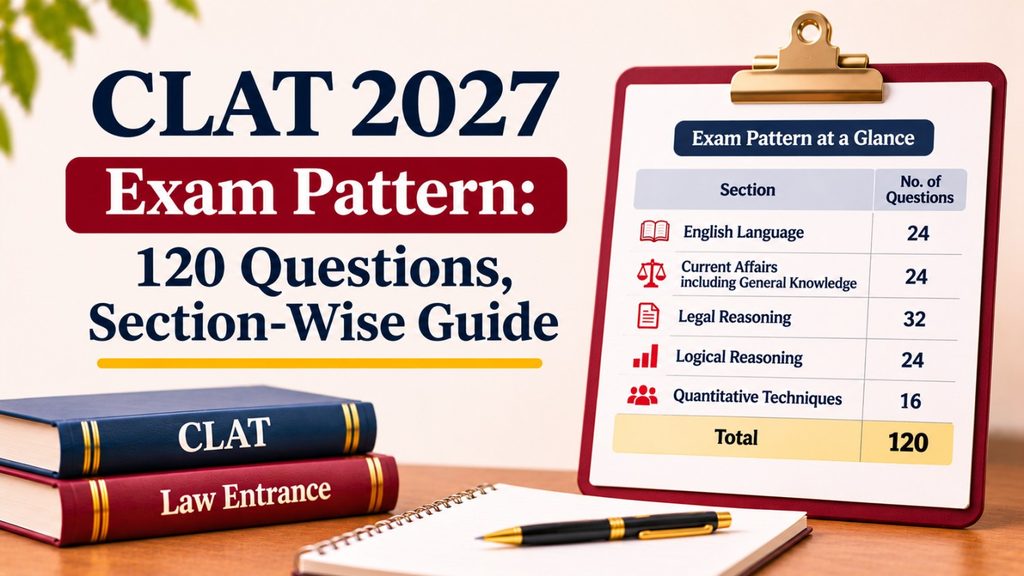
Understanding the CLAT 2027 exam pattern is the essential first step for any candidate aiming for admission into India’s premier National Law Universities (NLUs). Conducted as an offline, pen-and-paper test of 120 multiple-choice questions over two hours, the Common Law Admission Test evaluates reading comprehension and analytical reasoning rather than rote memorization. Beyond question counts, this standardized entrance framework operates under specific Indian statutory regulations, university bye-laws, and constitutional mandates that govern eligibility, reservation, and dispute resolution.
Regulatory Framework and Legal Context
The Common Law Admission Test is administered by the Consortium of National Law Universities, a non-profit society registered under Section 6 of the Karnataka Societies Registration Act, 1960. Through its Memorandum of Association and Bye-Laws, the Consortium coordinates admissions for 27 participating NLUs across India.
Legal education standards and admission eligibility are further regulated by the following statutory frameworks:
- The Advocates Act, 1961 (Section 7(1)(h)): Empowers the Bar Council of India (BCI) to promote legal education and lay down standards for universities imparting law degrees.
- Bar Council of India Rules of Legal Education, 2008 (Rule 5 and Rule 7): Prescribes minimum qualifying marks for five-year integrated law courses (45% for General/OBC/PwD/NRI and 40% for SC/ST candidates) and governs age-limit policies, with no upper age bar currently enforced.
- The Rights of Persons with Disabilities Act, 2016 (Section 17 and Section 32): Mandates inclusive examination accommodations, scribe facilities, compensatory time (20 minutes per hour), and a minimum 5% horizontal reservation in higher educational institutions.
- The Central Educational Institutions (Reservation in Admission) Act, 2006: Establishes statutory seat quotas for Scheduled Castes (15%), Scheduled Tribes (7.5%), and Other Backward Classes (27%), alongside the Constitution of India (Article 15(6)) providing up to 10% reservation for Economically Weaker Sections (EWS) in central institutions, subject to respective state NLU statutes.
CLAT 2027 Exam Pattern: Section-Wise Breakdown
According to the official CLAT 2027 syllabus and mock test structures released by the Consortium, the undergraduate paper consists of 24 comprehension passages of roughly 450 words each, followed by five questions per passage. Each correct answer awards 1 mark, while every incorrect answer incurs a negative marking penalty of 0.25 marks.
| Section | Passages | Questions | Marks | Core Focus Area |
| English Language | 5 | 25 | 25 | Main idea, tone, inference, contextual vocabulary |
| Current Affairs & GK | 6 | 30 | 30 | National/international news, governance, arts, history |
| Legal Reasoning | 6 | 30 | 30 | Principle-fact application, statutory logic, public policy |
| Logical Reasoning | 5 | 25 | 25 | Identifying premises, conclusions, assumptions, flaws |
| Quantitative Techniques | 2 | 10 | 10 | Class 10 data interpretation, ratios, percentages, algebra |
Visit the Official Consortium of NLUs Syllabus Page.
Selection, Tie-Breaking, and Grievance Procedures
To ensure fairness in a competitive ranking process, the Consortium enforces strict procedural rules:
- Candidate Obligations and Exceptions: Applicants must upload valid category or domicile certificates during registration. Candidates appearing in their Class 12 board exams may apply provisionally, provided they submit passing proof during final admission.
- Tie-Breaking Protocol: Under CLAT 2027 general instructions, if two candidates score identical marks, priority goes first to higher marks in the Legal Reasoning section, second to higher age, and third to a computerized draw of lots.
- Penalties and Remedies: Unfair means, impersonation, or tampering with OMR sheets results in immediate disqualification and debarment. For academic discrepancies, candidates can file formal objections against the provisional answer key via the official portal; if an objection is upheld by the Expert Committee, the challenge fee is refunded. Any legal disputes arising out of the test fall under the exclusive jurisdiction of courts in Bengaluru, where the Consortium is registered.
Frequently Asked Questions (FAQs)
The undergraduate test features 120 multiple-choice questions for a maximum of 120 marks, completed in 120 minutes.
Yes, 0.25 marks are deducted for each wrong answer, while unattempted questions carry zero penalty.
No. Passages state the governing legal principle, and candidates must apply only that principle to the given facts.
No. Following Bar Council of India rules and Consortium notifications, there is no upper age limit for UG-CLAT.
General, OBC, PwD, and NRI candidates need at least 45% aggregate marks, while SC and ST candidates require 40%.
Recommended Reads: