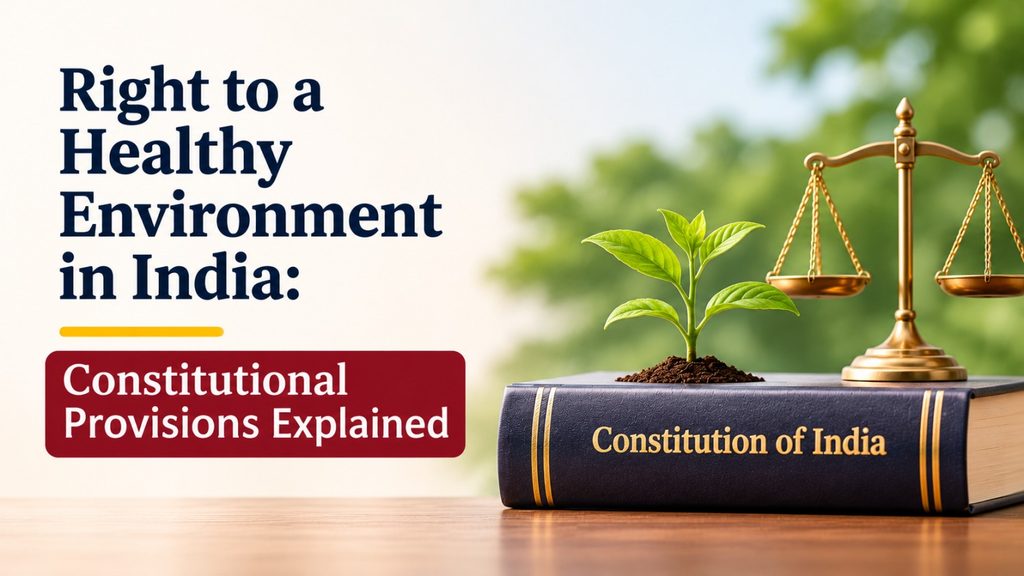
The right to healthy environment is not written in the Constitution in so many words, yet it is one of the most enforced rights in India. Courts have read it into the right to life, and Parliament has built laws and a special tribunal around it. This guide is for general readers and law students. It explains the constitutional provisions, the statutes behind them, and how to seek a remedy.
Is a Healthy Environment a Fundamental Right?
Article 21 protects life and personal liberty. Courts have long interpreted “life” to mean a life with dignity, which includes clean air, safe water and a pollution-free surroundings. So while no article says “healthy environment”, it is a recognised part of the fundamental right under Article 21. Fundamental rights can be enforced directly in court.
Key Constitutional Provisions on the Environment
| Provision | Nature | What it says | Enforceable? |
|---|---|---|---|
| Article 21 | Fundamental right | Life and liberty, read to include a healthy environment | Yes |
| Article 48A | Directive Principle (policy guidance to the State) | State must protect and improve the environment, forests and wildlife | Guides policy, not directly enforceable |
| Article 51A(g) | Fundamental duty | Every citizen must protect and improve the natural environment | Not directly enforceable, but informs courts |
| Articles 32 and 226 | Remedies | Writs (court orders) from the Supreme Court and High Courts | Yes |
| Article 253 | Treaty power | Parliament may legislate to implement international agreements | Basis for national environment laws |
| Seventh Schedule, Concurrent List (Entries 17A, 17B) | Law-making power | Forests, and wild animals and birds | Both Centre and States can legislate |
Articles 48A and 51A(g) were inserted by the 42nd Amendment, 1976.
Laws That Give Effect to the Right
- Environment (Protection) Act, 1986 (EPA): the umbrella law. Section 3 empowers the Central Government to protect and improve environmental quality.
- Water (Prevention and Control of Pollution) Act, 1974 and Air (Prevention and Control of Pollution) Act, 1981: regulate pollution through State Pollution Control Boards.
- National Green Tribunal Act, 2010: created the NGT (a specialist environmental tribunal) to hear environmental disputes.
- Van (Sanrakshan Evam Samvardhan) Adhiniyam, 1980: formerly the Forest (Conservation) Act, protects forest land. It was renamed in 2023.
- Wildlife Protection Act, 1972 and Biological Diversity Act, 2002: protect wildlife and biodiversity.
- Public Liability Insurance Act, 1991: provides relief for victims of hazardous-substance accidents.
- Bharatiya Nyaya Sanhita (BNS), 2023, Section 270 and Bharatiya Nagarik Suraksha Sanhita (BNSS), 2023, Section 152: deal with public nuisance and orders to remove it.
Rights, Duties and Obligations
| Who | Right or duty |
|---|---|
| Citizens | Right to a healthy environment under Article 21; duty to protect it under Article 51A(g) |
| State | Duty to protect the environment under Article 48A and to enforce environmental laws |
| Polluters | Duty to comply with statutory standards, pay penalties and restore damage |
How to Seek a Remedy: Step by Step
Pollution or violation → Complaint to Pollution Control Board or local authority → No action → NGT application, or writ in High Court (Article 226) or Supreme Court (Article 32) → Order: stop the activity, compensation, restoration → Appeal
Where to Go and Time Limits
| Forum | What you can seek | Time limit |
|---|---|---|
| NGT, Section 14 | Civil disputes with a substantial environmental question under listed laws | Six months from the cause of action |
| NGT, Section 15 | Compensation, relief and restoration | Five years |
| High Court, Article 226 | Writ for enforcement of rights | No fixed limit, but act promptly |
| Supreme Court, Article 32 | Writ for fundamental rights | No fixed limit, but act promptly |
An NGT order can be appealed to the Supreme Court under Section 22 of the NGT Act.
Penalties and Recent Amendments
The Jan Vishwas (Amendment of Provisions) Act, 2023 changed how violations of the EPA and the Air Act are punished. Imprisonment for most contraventions was replaced with monetary penalties, reported at ₹10,000 to ₹15 lakh, decided by an adjudicating officer (a government officer who decides the penalty). These changes took effect from 1 April 2024. An appeal against the officer’s order goes to the NGT within 60 days, with 10% of the penalty deposited. Failure to pay is still punishable with imprisonment. The Water (Amendment) Act, 2024 made similar changes, but the Water Act applies only in states that have adopted it.
Courts have also recognised protection from the effects of climate change as part of the rights to equality and life.
FAQs
Yes, as part of the right to life under Article 21, though the words do not appear in the Constitution.
Article 48A guides the State, while Article 51A(g) places a duty on citizens.
Article 32 allows it for fundamental rights, but the NGT or High Court is usually quicker and more practical.
Yes, but legal help is advisable because the NGT’s time limits are strict.
Six months for Section 14 disputes and five years for compensation claims under Section 15.
Want the deeper dive? Grab the reference book.