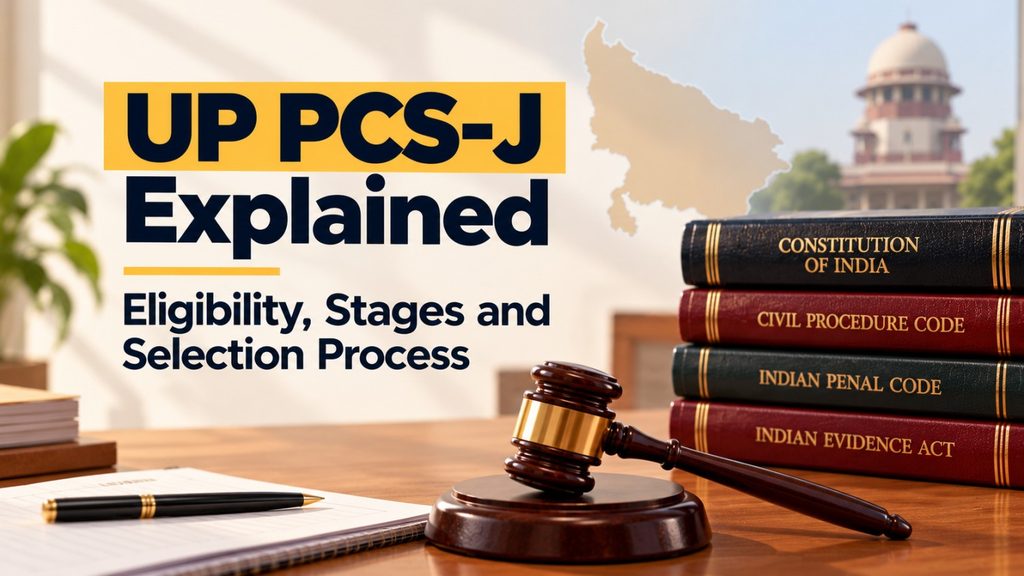
If you want to become a civil judge in Uttar Pradesh, start by understanding UP PCS J eligibility and how the exam is structured. The Provincial Civil Service (Judicial), or PCS-J, is the route to Civil Judge (Junior Division), the entry-level judicial post. This guide is written for law students and young graduates preparing for the UP judiciary exam, and it explains legal terms in plain language.
Legal Framework Behind the Exam: What Each Law Means for You
| Law | What it governs | Why it matters to you |
|---|---|---|
| Constitution, Articles 233 and 234 | Appointment of judges. Article 234 requires consultation among the Governor, State Public Service Commission and High Court | Explains why UPPSC and the High Court both shape the exam |
| Constitution, Article 235 | High Court control over subordinate courts | Governs your posting, discipline and promotion |
| UP Judicial Service Rules, 2001 | Qualifications, age and exam scheme | Main source for eligibility, so check for amendments |
| Advocates Act, 1961 | Enrolment with a State Bar Council | Basis of the enrolment and practice conditions |
| UP Public Services (Reservation) Act, 1994 | Reservation for SC, ST and OBC | Decides category-wise vacancies |
| Code of Civil Procedure 1908, Limitation Act 1963, Specific Relief Act 1963 | How civil suits run, filing deadlines, court remedies | Core of the civil law papers |
| Bharatiya Nyaya Sanhita (offences), Bharatiya Nagarik Suraksha Sanhita (procedure) and Bharatiya Sakshya Adhiniyam (evidence), all 2023 | The new criminal law framework | Tested in the law papers and used in magistrate duties |
UP PCS J Eligibility: Who Can Apply
- Nationality: Indian citizen.
- Education: an LLB degree from a recognised university, with eligibility to enrol as an advocate under the Advocates Act.
- Age: 22 to 35 years as of 1 July of the recruitment year, with five years of relaxation for SC, ST and OBC candidates with UP domicile and fifteen for persons with disabilities.
- Language: knowledge of Hindi in Devanagari script.
- Attempts: no fixed limit, so only the age cap applies.
The Practice Requirement
This is the biggest recent change. The Supreme Court’s May 2025 judgment required three years at the Bar, and the court has since reduced this to one year. The new rule applies to examinations after April 1, 2027, and transitional arrangements cover notifications issued before that date. Selected candidates will also complete a one-year judicial academy programme and a one-year supervised clerkship. The UP notification is expected between December 2026 and January 2027, so read its eligibility clause carefully.
UP PCS-J Exam Stages at a Glance
| Stage | Format | Marks | Role |
|---|---|---|---|
| Prelims | Objective: General Knowledge (150), Law (300) | 450 | Qualifying only |
| Mains | Six descriptive papers: General Knowledge 200, English 100, Hindi 100, three Law papers of 200 each | 1,000 | Counted |
| Interview | Personality test | 100 | Counted |
How the Selection Process Works
- Prelims: a qualifying screen with negative marking. Marks do not count toward final merit. Earlier cycles reportedly used a 40% cutoff, or 35% for SC and ST candidates.
- Mains: a written, subjective test of legal reasoning, drafting and language skills. Scoring above the minimum earns an interview call.
- Interview: assesses judicial temperament, communication and legal reasoning.
- Final merit: Mains and interview marks together make up 1,100 marks. Posts are then filled by merit and reservation category.
Frequently Asked Questions
The Uttar Pradesh Public Service Commission recruits, in consultation with the Allahabad High Court, as Article 234 requires.
It depends on which notification applies. The practice rule is changing, so check the official eligibility clause before applying.
No, only the age limit applies.
Yes. Knowledge of Hindi in Devanagari script is required, and Mains has a Hindi paper.
No. Prelims is only a screening test.