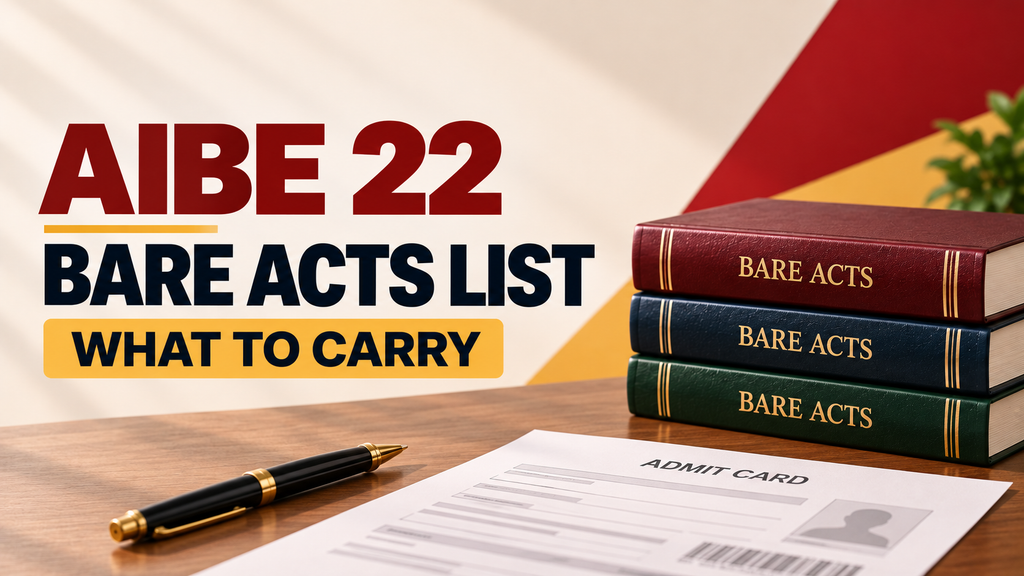
The AIBE 22 bare acts list is one of the most important things in your exam bag, because the All India Bar Examination is an open-book test. A bare act is the exact text of a law with no commentary. This guide is for law graduates and final-year students who will sit AIBE 22 on 29 November 2026. It lists what to carry, what to leave out and how to avoid problems at the gate.
What the Rules Say About Bare Acts
The Bar Council of India (BCI) runs the AIBE under its rule-making powers in the Advocates Act, 1961 (Section 49). Passing earns the Certificate of Practice required by the BCI Certificate and Place of Practice (Verification) Rules, 2015. Prep sources agree on these points:
- Candidates can carry bare acts without notes, comments or annotations.
- Books, notes, phones, smartwatches, calculators and bags are not allowed inside the centre.
- The number of bare acts you may carry is not fixed.
- You must carry your admit card and a photo ID.
Sources differ on photocopies, highlighting and bare acts with short notes. The safe rule is to carry clean, original printed bare acts and to read the instructions on your own admit card.
AIBE 22 Bare Acts List: Core Acts to Carry
BNSS stands for the Bharatiya Nagarik Suraksha Sanhita, 2023 (the new criminal procedure code). BSA stands for the Bharatiya Sakshya Adhiniyam, 2023 (the new evidence law).
| Subject | Bare act to carry |
|---|---|
| Constitutional law | Constitution of India, 1950 |
| Criminal law | Bharatiya Nyaya Sanhita, 2023 and Indian Penal Code, 1860 |
| Criminal procedure | BNSS, 2023 and Code of Criminal Procedure, 1973 |
| Evidence | BSA, 2023 and Indian Evidence Act, 1872 |
| Civil procedure | Code of Civil Procedure, 1908; Limitation Act, 1963 |
| Contract and sale | Indian Contract Act, 1872; Sale of Goods Act, 1930 |
| Specific relief | Specific Relief Act, 1963 |
| Property | Transfer of Property Act, 1882 |
| Negotiable instruments | Negotiable Instruments Act, 1881 |
| ADR | Arbitration and Conciliation Act, 1996 |
| Family law | Hindu Marriage Act, 1955; Hindu Succession Act, 1956; Special Marriage Act, 1954 |
| Land | Right to Fair Compensation and Transparency in Land Acquisition, Rehabilitation and Resettlement Act, 2013 |
| Professional ethics | Advocates Act, 1961 and BCI Rules |
| Others | Companies Act, 2013; Consumer Protection Act, 2019; Information Technology Act, 2000; Environment (Protection) Act, 1986 |
Prep sources report that the paper tests both the old and new criminal laws, so carry both sets. Check the official syllabus for any other subjects.
Allowed vs Not Allowed
| Item | Status |
|---|---|
| Printed bare act with no notes | Allowed |
| Bare act with commentary or annotations | Not allowed |
| Guides, textbooks, self-made notes | Not allowed |
| Highlighting, handwriting, sticky tabs | Sources differ, so avoid |
| Photocopies or loose sheets | Sources differ, so carry originals |
| Soft copies, phones, smartwatches | Not allowed |
| Calculator and bag | Not allowed |
| Admit card and photo ID | Required |
Exam Week Checklist
Buy clean printed editions → Remove anything written or stuck inside → Learn where each Act sits in your set → Pack by subject
→ Admit card + photo ID → Reach the centre early
How to Use Bare Acts During the Exam
- Treat the bare act as a lookup tool, not a teacher. It won’t explain anything, so you need to understand the topic first.
- Learn the chapter headings of each Act, so you can open the right page in seconds.
- Memorise old-to-new section conversions in the BNS, BNSS and BSA. Questions may use either set.
- Set a time cap per lookup. If you can’t find the section quickly, move on.
Common Mistakes
- Carrying a bare act with publisher’s notes or case summaries.
- Buying an older edition that lacks the new codes or recent amendments.
- Writing on the pages while revising. Mark a separate practice copy instead.
- Packing too many volumes and losing time handling them.
- Skipping the instructions printed on the admit card.
FAQs
Yes, but only for bare acts without notes or comments.
No.
Sources differ, so avoid it.
Reports differ. Original printed copies are safer.
No.
Recommended Resources: