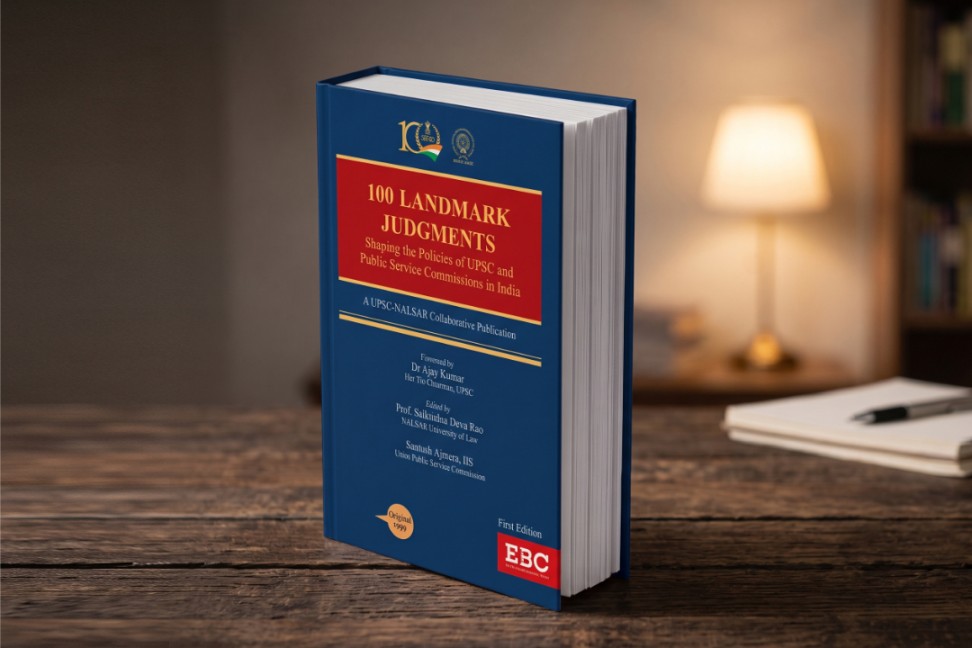
Public recruitment in India has been shaped by the courts as much as by the institutions that run the exams. A new book now collects that legal history in one place. “100 Landmark Judgments: Shaping the Policies of UPSC and Public Service Commissions in India“ was released by Prime Minister Narendra Modi at Bharat Mandapam, New Delhi, on 1 October 2026, as part of the Union Public Service Commission’s centenary celebrations.
What is the book?
It is a joint publication of the Union Public Service Commission (UPSC) and NALSAR University of Law, Hyderabad. It presents 100 important judgments that have influenced public employment and the functioning of the UPSC and the State Public Service Commissions.
Quick facts
- Editors: Prof. (Dr.) Srikrishna Deva Rao and Santosh Ajmera
- Publisher: Eastern Book Company
- Edition: 1st Edition, 2026
- Format: Hardback, 410 pages
- ISBN: 9788168089136
Why a book on judgments?
Recruitment looks administrative from the outside: notifications, exams, results, appointments. But every stage can be challenged in court. Candidates have questioned eligibility rules, evaluation methods, reservation, procedural lapses and age limits. Over the decades, those cases have built up principles that every recruiting body now has to follow.
The cases highlight constitutional principles such as equality, fairness and protection from arbitrary action. They draw on Articles 14 and 16 of the Constitution and the provisions on public services in Part XIV. The book shows that public employment law sits at the intersection of constitutional and administrative law.
Who made it?
The book was compiled by a dedicated research team at NALSAR, working in coordination with designated UPSC officials. It carries:
- A Foreword by Dr Ajay Kumar, Chairman, UPSC
- An Acknowledgment by Shri Shashi Ranjan Kumar, IAS, Secretary, UPSC
- An Introduction by Prof. (Dr.) Srikrishna Deva Rao, Vice-Chancellor, NALSAR
Prof. Rao has said the collaboration reflects the belief that a university fulfils its purpose when rigorous scholarship serves public institutions.
How is it organised?
The book is arranged in ten thematic chapters and not by year or court. The themes include constitutional foundations of the Commissions, appointments and eligibility, recruitment procedures, reservation, examinations and evaluation, administrative discretion, governance and accountability, and age relaxation and sports quota.
Each case note covers the facts, issues, decision and ratio, along with the relevant constitutional and legal provisions, and the publisher lists a significance section for each case.
For a full chapter-by-chapter guide, read our companion post: [What’s Inside “100 Landmark Judgments”: A Reader’s Guide].
Why does it matter?
- It brings scattered case law together. Judgments on recruitment are spread across decades and courts. A structured compilation saves officials, lawyers and students a lot of searching.
- It is built for practical use. The fixed case-note format lets readers quickly see what a case decided and why it matters.
- It records the legal history of a century-old institution. It shows how the courts have shaped recruitment policy, which makes it a fitting centenary publication.
- It supports fairness and transparency. By setting out the standards recruiting bodies are held to, it helps candidates and institutions understand what a fair process requires.
Who is it for?
The publisher lists Public Service Commissions, government departments, practitioners, scholars, students and aspirants. Civil services aspirants should treat it as background on the legal principles behind the exam system and not as a syllabus-based prep book.
Frequently asked questions
Prime Minister Narendra Modi released it at Bharat Mandapam, New Delhi, on 1 October 2026, during the UPSC centenary celebrations.
Eastern Book Company, as a collaboration between the UPSC and NALSAR University of Law.
100
It is a legal reference that can help aspirants understand the principles behind the system. It is not a syllabus-based guide.
Curious for more? Check out the book here.