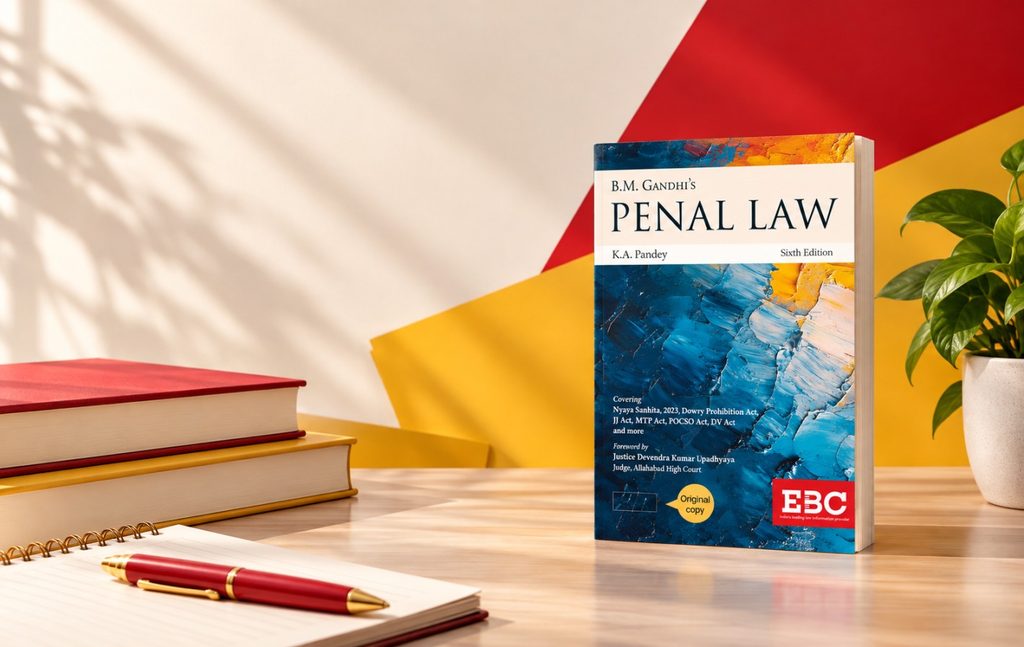
Since the Bharatiya Nyaya Sanhita, 2023 (BNS) replaced the Indian Penal Code, 1860 (IPC), students keep asking which book to trust. If you are wondering whether B.M. Gandhi Penal Law is good for LLB and judiciary exams, the short answer is yes, with a few caveats. This guide is written mainly for LLB and LLM students and judicial service aspirants, and it explains what the book covers and who benefits most.
About the Book
The 6th Edition (2026) is revised by Dr. K.A. Pandey and published by Eastern Book Company. It runs to 1,112 pages and follows the BNS, which came into force on 1 July 2024 and has 358 sections against the IPC’s 511.
Its core idea is that the BNS cannot be studied alone. Chapters pair the main offences with connected special laws, meaning statutes outside the main code that create their own offences and procedures.
Laws Covered in the Book
- Bharatiya Nyaya Sanhita, 2023: the main substantive criminal law, which defines offences and sets punishments.
- POCSO Act, 2012: punishes sexual offences against children.
- Juvenile Justice (Care and Protection of Children) Act, 2015: governs how children in conflict with law are treated.
- Dowry Prohibition Act, 1961 and Domestic Violence Act, 2005: address dowry and abuse within the home.
- MTP Act, 1971 and PCPNDT Act, 1994: regulate abortion and ban sex selection.
- Sexual Harassment of Women at Workplace Act, 2013: deals with workplace complaints.
- Prevention of Corruption Act, 1988: covers bribery by public servants.
- Information Technology Act, 2000: covers cyber offences.
- MCOCA, 1999: targets organised crime.
- Other laws: Immoral Traffic (Prevention) Act, 1956; Contempt of Courts Act, 1971; Representation of the People Act, 1951; Motor Vehicles Act, 1988; Food Safety and Standards Act, 2006; Drugs and Cosmetics Act, 1940; Coinage Act, 2011; and the Environment, Water and Air pollution Acts.
How the Book Links Laws
| Topic | BNS provision | Connected law in the book |
|---|---|---|
| Dowry death, cruelty | Sections 80 and 85 | Dowry Prohibition Act, DV Act |
| Organised crime | Section 111 | MCOCA |
| Public servant offences | Chapter on public servants | Prevention of Corruption Act |
| Child liability | General exceptions | JJ Act |
| Cyber matters | Relevant chapters | IT Act |
Rights, Penalties and Procedure
Punishments under the BNS include death, life imprisonment, rigorous or simple imprisonment, fine, forfeiture of property and, newly, community service for certain petty offences. Three appendices cover the rights of the accused and prisoner, penology (the study of punishment) and victimology (the study of victims and their rights).
Procedure sits in the Bharatiya Nagarik Suraksha Sanhita, 2023 (BNSS), which replaced the Code of Criminal Procedure. Proof sits in the Bharatiya Sakshya Adhiniyam, 2023 (BSA), which replaced the Evidence Act. This book covers substantive law, so pair it with books on those two.
Offence (BNS) → Special law, if any → Punishment → Trial (BNSS) → Proof (BSA)
Is It Good for LLB Students?
Yes. The commentary style gives the meaning, principle, object, scope, explanations and exceptions for each topic, and it explains how similar sections differ. Every chapter opens with an overview, and the Table of Cases and Subject Index help revision.
Is It Good for Judiciary Exams?
Largely yes. Judicial service papers test the BNS along with special laws, and this book collects them in one place. The limits are its size and its scope, since exams also test the BNSS and BSA. Use it for deep study, then switch to a bare act and short notes for revision. Lawyers, police officers, teachers and researchers will also find it useful as a reference.
Use up and down arrow keys to resize the meta box pane.
FAQs
Yes. The 6th Edition (2026) is revised around the BNS, 2023.
For offences committed before 1 July 2024, the IPC can still apply under the repeal and savings provisions of the BNS, which the book covers in its final chapter.
Not alone. Add books on the BNSS and BSA, plus bare acts.
Yes, both are discussed alongside the related BNS offences.
At 1,112 pages it is long, but chapter overviews help. Read the overview first, then the detail.
Curious for more? Grab the book now!