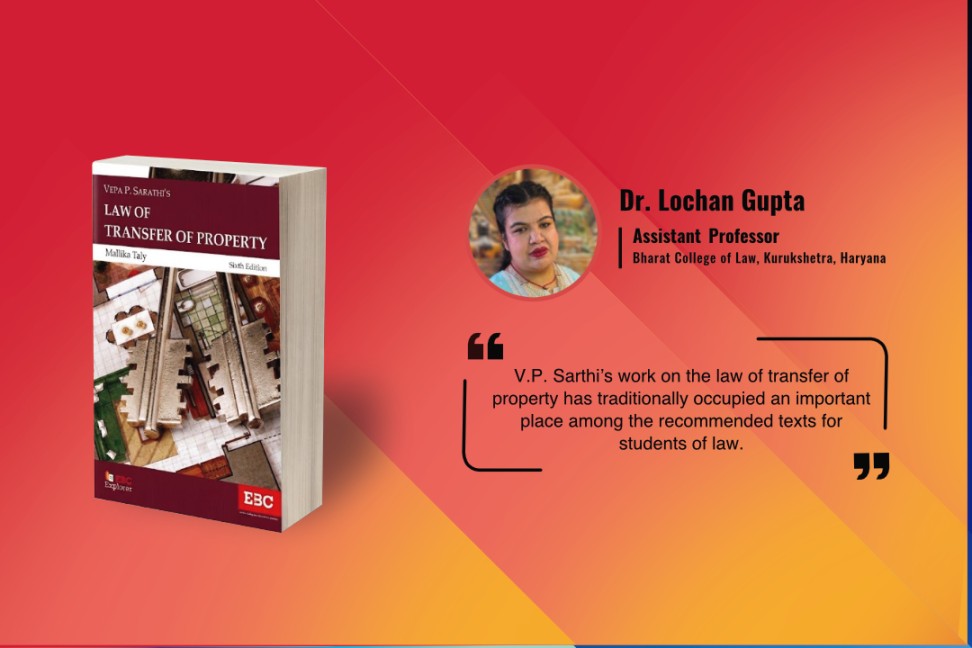
The law relating to transfer of property occupies a fundamental position in the study and practice of Indian private law. The Transfer of Property Act, 1882 provides the principal statutory framework governing voluntary transfers of property inter vivos and regulates a wide range of transactions involving sale, mortgage, lease, exchange, gift and actionable claims. Its significance extends beyond academic study because property transactions constitute an integral part of everyday commercial, familial and civil relationships. Against this background, V.P. Sarthi’s Transfer of Property – New Edition represents a significant contribution to contemporary legal literature and legal education. V.P. Sarthi’s work on the law of transfer of property has traditionally occupied an important place among the recommended texts for students of law. University syllabi across India continue to identify Sarthi’s work among the standard references for Property Law and the Transfer of Property Act. The present new edition, authored by Monica Talay, seeks to retain the conceptual and doctrinal strengths associated with the subject while presenting the law in a manner suitable for the contemporary learner and legal researcher.
Scope and Academic Significance
One of the principal strengths of the book is its engagement with the foundational principles governing transfer of property. The subject requires students to understand not merely individual statutory provisions but also the relationship between concepts, doctrines and judicial interpretation. A sound treatment of property law must therefore explain the statutory framework while simultaneously demonstrating how courts have interpreted and applied it. The book addresses the major dimensions of the law of transfer of property, including the nature and operation of transfers, competency of transferors, transferable and non-transferable interests, transfers for the benefit of unborn persons, vested and contingent interests, conditions and restrictions on transfer, and the rule against perpetuity. These doctrines form the conceptual foundation upon which the subsequent provisions of property law operate.
Equitable and Protective Doctrines
Particularly valuable in the study of the subject are the equitable and protective doctrines developed around the statutory framework. Doctrines such as feeding the grant by estoppel, transfer by ostensible owner, lis pendens, fraudulent transfer and part performance demonstrate the manner in which property law attempts to balance competing interests— certainty of transactions, protection against fraud, good faith, equitable conduct and the security of property rights. Their treatment is essential for developing the analytical skills expected of law students and practitioners.
Treatment of Sale, Mortgage and Other Transfers
The treatment of specific modes of transfer is another important dimension of the work. Sale of immovable property constitutes one of the most practically significant areas of property law, and its study requires an understanding of both statutory requirements and judicially developed principles. Similarly, the law of mortgages and charges involves a sophisticated balance between the interests of mortgagors and mortgagees. A comprehensive property-law text must therefore go beyond definitions and classifications and explain the rights and liabilities arising from these relationships. Issues relating to different forms of mortgage, redemption, foreclosure, priority, marshalling, contribution and subrogation are central to the subject and have considerable practical importance. The book’s treatment of these areas contributes to its usefulness for both academic and professional purposes.
Lease, Exchange and Gift
The chapters concerning lease, exchange and gift further broaden the scope of the book. Lease law, in particular, involves recurring practical questions concerning creation, duration, rights and liabilities of lessors and lessees, determination of leases and forfeiture. The treatment of gifts introduces students to the special requirements governing voluntary transfers without consideration, while exchange illustrates the statutory recognition of reciprocal transfers of ownership.
Doctrinal Clarity and Case-Law Orientation
A notable feature of a good property-law textbook is its ability to bridge the gap between statutory language and judicial interpretation. The Transfer of Property Act is a statute in which many provisions acquire their practical meaning through case law. Consequently, the study of leading judicial decisions is indispensable. The broader academic tradition surrounding Sarthi’s work has long been connected with important authorities that are regularly included in Indian university curricula. These include decisions concerning sale and lease, mortgages, conditions of transfer, part performance and related doctrines. University syllabi prescribing Sarthi commonly place the work alongside leading authorities such as Associated Hotels of India Ltd. v. R.N. Kapoor, Chunchun Jha v. Sheikh Ebadat Ali, and other foundational decisions. The inclusion and explanation of judicial principles are particularly useful for students preparing for university examinations, competitive examinations and professional legal practice. Rather than viewing the Act as a collection of isolated sections, students are encouraged to understand the interaction between statutory rules and judicial reasoning.
Contemporary Relevance of Property Law
The continuing relevance of property law cannot be overstated. Questions relating to ownership, possession, sale, mortgage, tenancy, family arrangements and transfer of property frequently arise before civil courts and other legal forums. At the same time, contemporary property transactions increasingly involve questions relating to registration, documentation, contractual arrangements and the evidentiary consequences of improperly executed transactions. The relevance of the subject is also reflected in contemporary legal education. University curricula continue to include the Transfer of Property Act as a core component of Property Law, covering subjects such as general principles of transfer, sale, mortgage, lease, gift, exchange, actionable claims and easements. In this context, a new edition is valuable when it enables students to approach traditional statutory principles through contemporary legal understanding. Dr. Lochan Gupta’s edition mayconsequently be viewed as part of the continuing effort to make an established area of law accessible to a new generation of law students, researchers and practitioners.
Utility for Students, Researchers and Practitioners
The book has considerable pedagogical value. For undergraduate and postgraduate law students, it provides a structured pathway through one of the more conceptually demanding branches of civil law. The subject contains numerous doctrines whose terminology can initially appear difficult; systematic explanation is therefore particularly important. For LL.M. students and research scholars, the work provides a useful doctrinal foundation from which more advanced research questions can be developed. Researchers examining property rights, land transactions, tenancy, secured transactions or private law can use the statutory and doctrinal framework as a starting point for deeper inquiry. For legal practitioners, a reliable treatment of the principal provisions and doctrines of the Transfer of Property Act can function as a useful reference for identifying relevant legal principles before undertaking more detailed examination of current judicial authorities and applicable procedural or regulatory requirements. The work also has value for legal educators. Property Law is often perceived by students as a technically complex subject because it combines statutory provisions, equitable doctrines and extensive case law. A well-structured text can therefore facilitate classroom teaching by providing a coherent conceptual framework.
Critical Appraisal
From an academic perspective, the principal strength of the work lies in its focus on conceptual understanding combined with statutory and case-law analysis. The subject demands precision, because seemingly minor distinctions—such as those between vested and contingent interests, lease and licence, sale and agreement to sell, mortgage and charge, or void and voidable conditions—can produce substantially different legal consequences. The continuing presence of Sarthi’s work in university reading lists demonstrates its established academic relevance. The new edition therefore benefits from a strong intellectual foundation while providing an opportunity to present the subject for contemporary legal education. At the same time, readers should recognize that property law is a continuously developing field. Statutory amendments, changes in registration and land-related regulations, and subsequent judicial decisions may affect the application of principles discussed in any textbook. Accordingly, students and practitioners should use the book together with the current statutory text and the latest authoritative judicial decisions.
Conclusion
V.P. Sarthi’s Transfer of Property – New Edition by Monica Taly is a significant academic contribution to the study of Property Law in India. By focusing on the fundamental principles of transfer, statutory provisions, important doctrines and judicial interpretation, the work addresses the requirements of contemporary legal education while preserving the enduring importance of the subject. Its significance lies not merely in explaining the Transfer of Property Act, 1882, but in helping readers understand the legal relationships that arise when rights and interests in property are transferred from one person to another. The doctrines of sale, mortgage, lease, gift, exchange, actionable claims, lis pendens, part performance, fraudulent transfer and related principles continue to have substantial practical implications. The new edition is consequently relevant to LL.B. and LL.M. students, research scholars, teachers, legal practitioners and candidates preparing for competitive examinations. It can serve as a bridge between classroom learning and the practical understanding of property transactions.
In an era in which property transactions are becoming increasingly complex and legally regulated, a systematic and accessible treatment of the subject is particularly valuable. Monika Taly’s new edition of V.P. Sarthi’s Transfer of Property contributes to this objective by bringing an established property-law tradition into the contemporary academic environment. It is, therefore, a useful addition to the library of students and scholars of Indian Property Law and a relevant reference for those seeking a structured understanding of one of the foundational branches of private law.
Want the deeper dive? Grab the reference book.