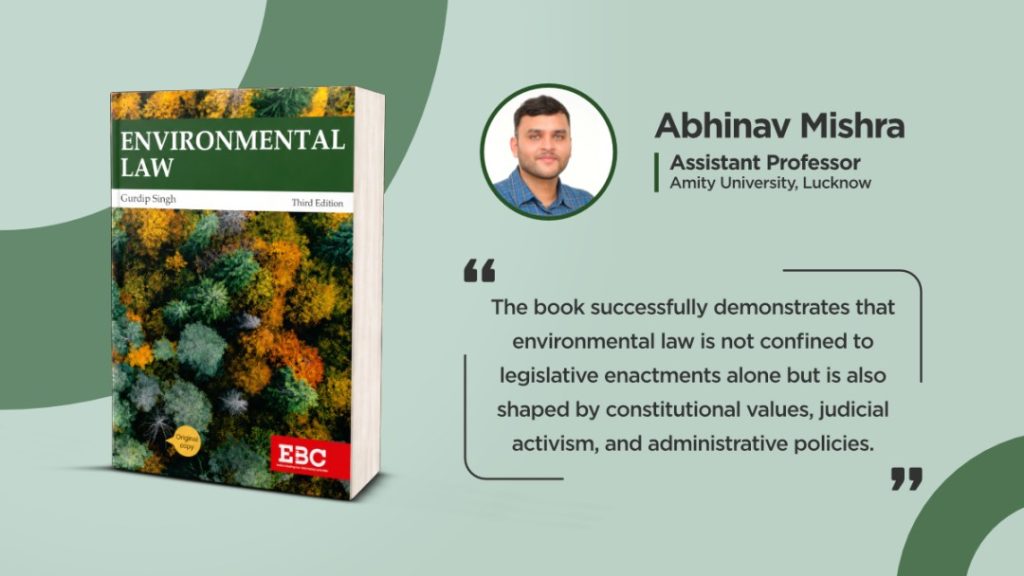
As environmental concerns increasingly shape public policy, governance, and legal discourse, the study of environmental law has become indispensable for law students, researchers, and practitioners. Environmental Law by Gurdip Singh and Amrita Bahri emerges as a comprehensive and insightful resource that effectively captures the evolution, structure, and contemporary relevance of environmental regulation in India.
Moving Beyond Statutory Text
One of the most remarkable features of this book is its analytical approach. Rather than merely reproducing legislative provisions, the authors delve into the objectives, scope, and practical implications of environmental laws. Through detailed discussions on judicial interpretation and policy developments, readers gain a deeper understanding of how environmental laws operate in practice and contribute to environmental governance.
The book successfully demonstrates that environmental law is not confined to legislative enactments alone but is also shaped by constitutional values, judicial activism, and administrative policies. This integrated approach makes the subject more accessible and meaningful for readers seeking to understand the broader legal landscape.
A Holistic View of Environmental Governance
The authors skillfully weave together constitutional provisions, statutory frameworks, and landmark judicial decisions to present a holistic picture of environmental governance in India. The discussion highlights the judiciary’s pivotal role in expanding environmental rights and enforcing environmental accountability through innovative legal principles and progressive interpretations
By examining significant case laws and legislative developments, the book enables readers to appreciate the dynamic nature of environmental jurisprudence and the continuing evolution of environmental protection mechanisms in India.
Academic Rigor and Practical Relevance
Written in a formal, precise, and academically rigorous style, the book is particularly valuable for law students, academicians, researchers, and legal professionals. The chapters are logically organized, allowing readers to progress systematically through various aspects of environmental law.
The inclusion of significant judicial pronouncements strengthens the book’s academic value, while discussions on policy initiatives and regulatory frameworks provide practical insights into the functioning of environmental governance institutions. As a result, the book serves not only as a classroom resource but also as a reliable reference for legal research and professional practice
Connecting Domestic and International Environmental Law
An important strength of the book is its treatment of international environmental principles and India’s treaty obligations. The authors explain how global environmental commitments influence domestic legal developments and contribute to the formulation of environmental policies in India.
This discussion helps readers understand the interconnected nature of environmental regulation in an increasingly globalized world and highlights India’s role within the broader framework of international environmental governance
Areas for Further Enhancement
While the book offers extensive coverage of environmental law, certain aspects could have been explored further. The detailed discussion of statutory provisions and judicial decisions may occasionally appear dense for readers who are new to legal studies. Additionally, although international environmental law is addressed, the primary focus remains on Indian legal developments. A more comparative examination of environmental legal systems across different jurisdictions could have provided readers with broader perspectives and enriched the analytical depth of the text.
One notable area that deserves greater attention is the historical evolution of international environmental law. A more detailed exploration of the origins and development of global environmental governance would be particularly beneficial for students and researchers engaged in advanced academic work
A Valuable Resource for Future Environmental Lawyers
Despite these minor limitations, Environmental Law by Gurdip Singh and Amrita Bahri stands out as an authoritative and indispensable resource on environmental jurisprudence. Its balanced integration of constitutional principles, statutory provisions, policy analysis, and judicial developments makes it an excellent guide for understanding India’s environmental legal regime.
For law students seeking conceptual clarity, researchers exploring environmental governance, and practitioners keeping pace with evolving legal developments, this book offers both depth and practical relevance. It remains a highly recommended addition to every law library and an essential companion for anyone interested in the growth and future of environmental law in India.
Want the deeper dive? Grab the reference book.