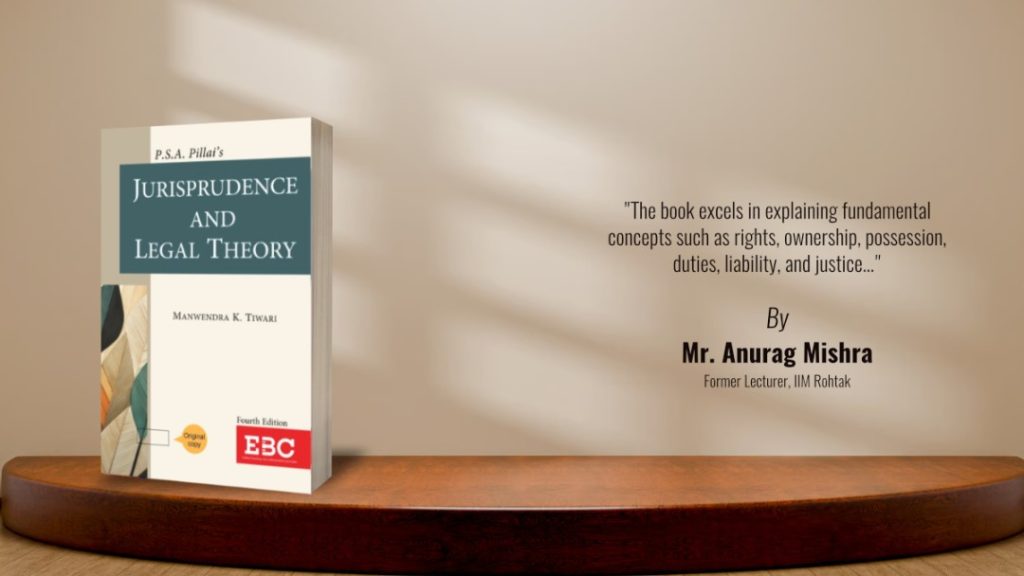
This review examines PSA Pillai’s Jurisprudence and Legal Theory, revised by Manwendra K. Tiwari, a foundational text for understanding the philosophical and theoretical foundations of law. Reviewed by Mr. Anurag Mishra, Former Lecturer at IIM Rohtak, this piece assesses the book’s clarity, structure, and continued relevance for students of jurisprudence. The revised edition retains Pillai’s analytical depth while incorporating contemporary perspectives and updated scholarship, making it valuable for students and academicians alike.
Understanding the Foundations of Law
Jurisprudence forms the intellectual foundation of legal education, helping readers understand not only what the law is but also the philosophy and principles that shape it. P.S.A. Pillai’s Jurisprudence and Legal Theory offers a comprehensive yet concise introduction to this fascinating subject. By combining classical schools of legal thought with modern jurisprudential developments, the book provides readers with a balanced understanding of the evolution of legal philosophy.
A Perfect Blend of Classical and Contemporary Thought
One of the defining strengths of this book is its ability to seamlessly integrate traditional jurisprudential theories with contemporary legal perspectives. It introduces readers to the ideas of eminent jurists and the major schools of legal thought while demonstrating their continued relevance in today’s legal system. This balanced approach makes the subject both academically enriching and practically meaningful
Simplifying Complex Legal Concepts
The book excels in explaining fundamental concepts such as rights, ownership, possession, duties, liability, and justice in a lucid and reader-friendly manner. Subjects that often appear abstract and conceptually challenging are broken down into clear explanations, enabling readers to build a strong conceptual foundation without feeling overwhelmed. This clarity makes the book equally useful for first-time learners as well as those revisiting jurisprudence for advanced study.
Well-Structured for Effective Learning
Another notable feature of the book is its systematic organization. The chapters progress logically, allowing readers to understand each concept before moving on to more advanced discussions. The concise yet comprehensive writing style ensures that the content remains engaging while covering the essential dimensions of jurisprudence. This thoughtful structure makes the book particularly effective for classroom learning, self-study, and examination preparation.
An Indispensable Resource for Legal Scholars
Whether one is a law student beginning the study of jurisprudence, a teacher guiding students through legal philosophy, or a legal practitioner seeking to revisit foundational concepts, this book serves as a dependable academic companion. Its combination of conceptual clarity,scholarly depth, and accessible presentation makes it an invaluable reference for anyone interested in understanding the theoretical foundations of law.
By presenting complex legal theories in a clear, structured, and engaging manner, P.S.A. Pillai’s Jurisprudence and Legal Theory succeeds in making one of the most intellectually demanding subjects in legal education both approachable and rewarding.
Want the deeper dive? Grab the reference book.