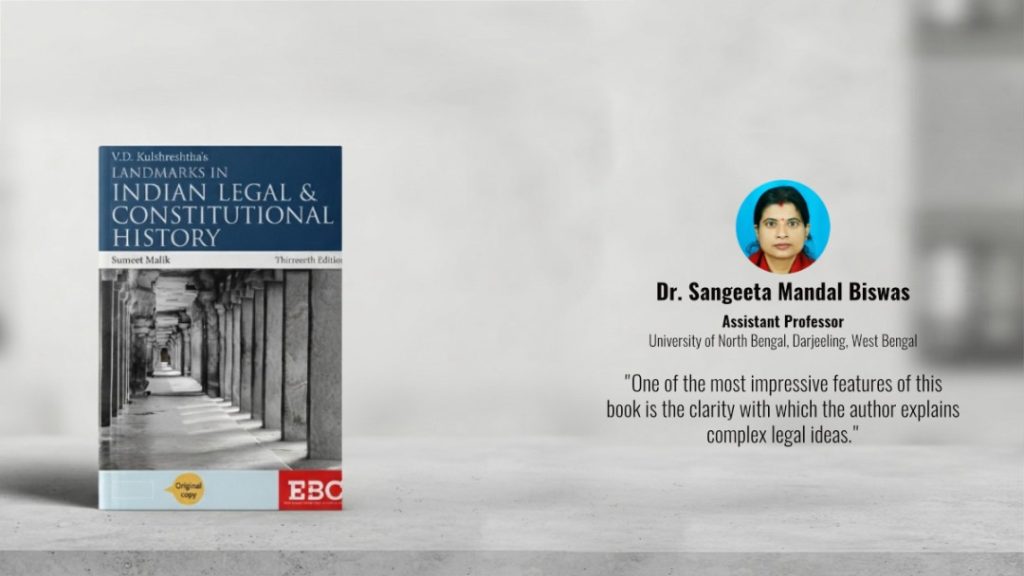
VD Kulshreshtha’s Landmarks in Indian Legal and Constitutional History traces India’s legal evolution from ancient customs through colonial codification to the modern constitution. Now in its 12th edition, it remains a key text for students of legal history. This review by Dr. Sangeeta Mandal Biswas, Assistant Professor at the University of North Bengal, Darjeeling, critically examines its content and lasting relevance.
A good legal textbook does much more than present rules and definitions. It should guide readers through the structure of the subject, encourage analytical thinking, and help them connect theory with practice. This book succeeds on all these counts. It is a thoughtfully written academic work that combines clarity, depth, and practical relevance in a manner that makes it highly valuable for law students, teachers, and researchers alike.
From the very beginning, the book establishes itself as a dependable scholarly resource. Its systematic organization and lucid style make it easy to follow, while its academic depth ensures that it remains useful beyond the classroom. It is the kind of book that not only supports examination preparation but also strengthens a reader’s conceptual foundation in law
Clarity of Presentation
One of the most impressive features of this book is the clarity with which the author explains complex legal ideas. Legal subjects often involve technical language, layered concepts, and detailed statutory interpretation. Yet the author has managed to present these ideas in a way that is accessible without being simplistic.
The explanations are precise, well-structured, and easy to understand. This makes the book especially useful for students who are still developing familiarity with the subject. At the same time, the clarity of expression also benefits teachers and advanced readers who may wish to use the book as a reference for classroom discussion or academic analysis.
Comprehensive Coverage of the Subject
Another major strength of the book is its comprehensive treatment of the subject matter. The author has covered the relevant topics in a thorough and balanced manner, ensuring that readers receive a complete understanding of the area of law under discussion.
The content is not limited to theoretical exposition. It also incorporates statutory provisions, judicial decisions, and practical observations that enrich the reader’s understanding. This combination of sources gives the book both authority and depth. Readers are able to see how legal principles operate in real contexts, which is essential for meaningful legal education.
Systematic Organization and Logical Flow
A well-organized textbook makes learning easier, and this book excels in that respect. The topics are arranged in a logical sequence that allows readers to move smoothly from one concept to the next. Each chapter builds upon the previous one, creating a coherent learning experience.
This systematic structure is particularly helpful for students preparing for examinations or revising the subject. It allows them to locate topics quickly and understand how different aspects of the law are connected. The logical flow of the book also reflects the author’s strong command over the subject and commitment to effective pedagogy
Academic Rigor with a Reader-Friendly Style
What makes this book especially commendable is the balance it strikes between academic rigor and readability. Many legal texts are either too dense for students or too simplified to be academically useful. This book avoids both extremes. It maintains scholarly seriousness while remaining approachable and engaging.
The language is lucid, the arguments are well-developed, and the presentation is disciplined. As a result, the book can be used confidently for classroom teaching, self-study, and research. It is suitable for learners at different stages of legal education, from beginners to more advanced students seeking a deeper understanding of the subject.
Usefulness for Teaching and Learning
From a faculty perspective, this book is an excellent teaching aid. Its structure and content make it easy to integrate into lectures, tutorials, and discussions. The explanations are sufficiently detailed to support classroom instruction, while the clarity of the writing helps students grasp difficult concepts with greater ease.
For students, the book serves as a reliable companion throughout their academic journey. It can be used for preparing notes, revising key topics, and developing a stronger conceptual base. Its practical utility extends beyond examinations, making it a valuable reference for future legal study and professional development.
Value for Research and Advanced Study
In addition to being a strong textbook, this book also has considerable value for research- oriented readers. The inclusion of statutory references and judicial precedents provides a solid foundation for further inquiry. Readers who wish to explore the subject in greater depth will find the book a useful starting point for academic research and critical analysis.
Its reliability and scholarly tone make it suitable for those who require an authoritative source. Whether one is writing a paper, preparing a seminar presentation, or engaging in doctrinal study, the book offers a dependable framework for understanding the subject in a meaningful way
A Book That Encourages Critical Thinking
A truly effective legal book should do more than inform; it should also inspire readers to think critically about the law. VD Kulshreshtha’s Landmarks in Indian Legal and Constitutional History achieves that objective by presenting legal principles in a manner that invites reflection and analysis. It encourages readers to move beyond memorization and engage with the subject intellectually.
This quality is especially important in legal education, where the ability to interpret, question, and apply legal rules is as important as knowing them. The book supports this kind of learning by combining doctrinal clarity with analytical depth.
Overall, this book is a brilliant piece of academic work that deserves a place in every law student’s library. It is comprehensive, well-organized, and written with a level of clarity that makes it both accessible and authoritative. Its value lies not only in the information it provides but also in the way it helps readers develop a deeper understanding of the law.
As a faculty member, I found it to be an outstanding academic resource and have confidently recommended it to my students as an essential reference for their studies. It is a book that will undoubtedly benefit students, teachers, researchers, and legal professionals seeking a dependable and scholarly guide.
In every sense, this is a publication that reflects the highest standards of legal writing and academic usefulness. It is a commendable contribution to legal literature and a resource that will continue to serve readers well.