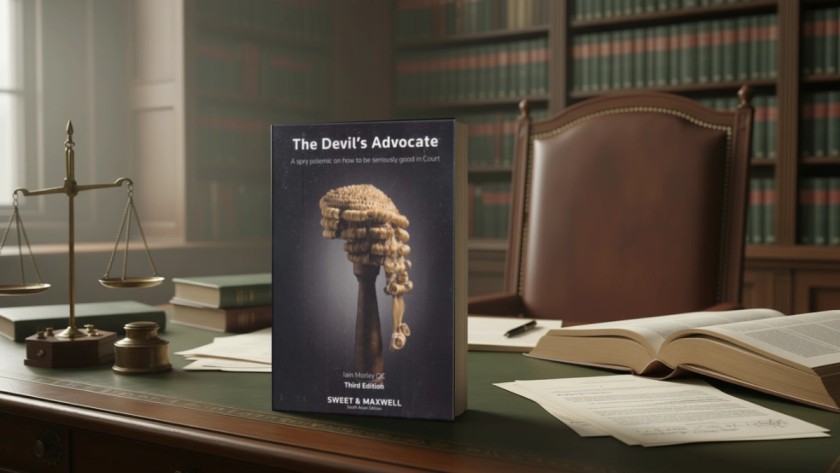
Advocacy is often taught as a set of rules: what to say, when to stand, how to cross-examine. The Devil’s Advocate takes a different route. It focuses not just on what good advocates do, but how they learn to do it well in real courtrooms.
Written with humour and clarity, The Devil’s Advocate offers a practical, step-by-step guide to advocacy that bridges the gap between theory and practice. It is designed for advocates in their first five years, but its lessons resonate far beyond that stage.
A Practical Guide, Not a Theoretical Treatise
This book does not drown the reader in abstract principles. Instead, it walks through advocacy as it is actually practised—from preparation, to speech-making, to questioning witnesses under pressure.
The emphasis is on:
- understanding your role in an adversarial courtroom,
- making decisions in real time,
- and learning how small choices affect credibility and persuasion.
It is advocacy explained from the inside, not from the lecture hall.
Bridging the Gap Between Knowing and Doing
One of the book’s central strengths is how it connects reading about advocacy with performing it in court. Many students and junior advocates know the rules but struggle to apply them under stress.
The Devil’s Advocate tackles this directly by:
- explaining why common mistakes happen,
- showing how good habits are built gradually,
- and encouraging reflection after each appearance in court.
The result is a guide that helps advocates turn knowledge into skill.
The Art of Persuasion, Explained Simply
Persuasion lies at the heart of advocacy, and the book treats it as a discipline, not a personality trait. It explains:
- how to make convincing submissions without theatrics,
- how structure and clarity matter more than flourish,
- and why restraint often persuades more effectively than force.
Speeches are broken down into their essential components, making them easier to plan, deliver, and improve.
Cross-Examination and Witness Control
Cross-examination is one of the most intimidating aspects of advocacy. This book demystifies it.
It describes:
- well-established questioning techniques used in court,
- exercises for improving control over witnesses,
- and methods for maintaining focus under pressure.
Importantly, it stresses that effective cross-examination is not about aggression, but about precision, preparation, and judgment.
Punchy Advice That Sticks
Throughout the book, short observations and practical comments reinforce key lessons. Examples are used consistently to illustrate what works and what does not.
This approach:
- improves understanding,
- aids memory,
- and helps readers recognise these situations when they arise in real cases.
The conversational tone makes complex ideas accessible without oversimplifying them.
Advocacy Beyond National Courts
A newer chapter addresses advocacy before International Criminal Tribunals, where courtroom dynamics require additional skills. These forums demand heightened sensitivity to:
- cultural differences,
- procedural complexity,
- and the unique role of international judges and counsel.
By including this material, the book acknowledges that good advocacy principles must sometimes adapt to different legal environments.
Who Should Read This Book?
The Devil’s Advocate can be used in any adversarial courtroom, in any jurisdiction. It is particularly valuable for:
- law students learning advocacy,
- junior advocates building courtroom confidence,
- and anyone seeking a clearer understanding of what “good” advocacy really means.
It is not a book to read once and shelve. As the subtitle suggests: read it, keep it with you.