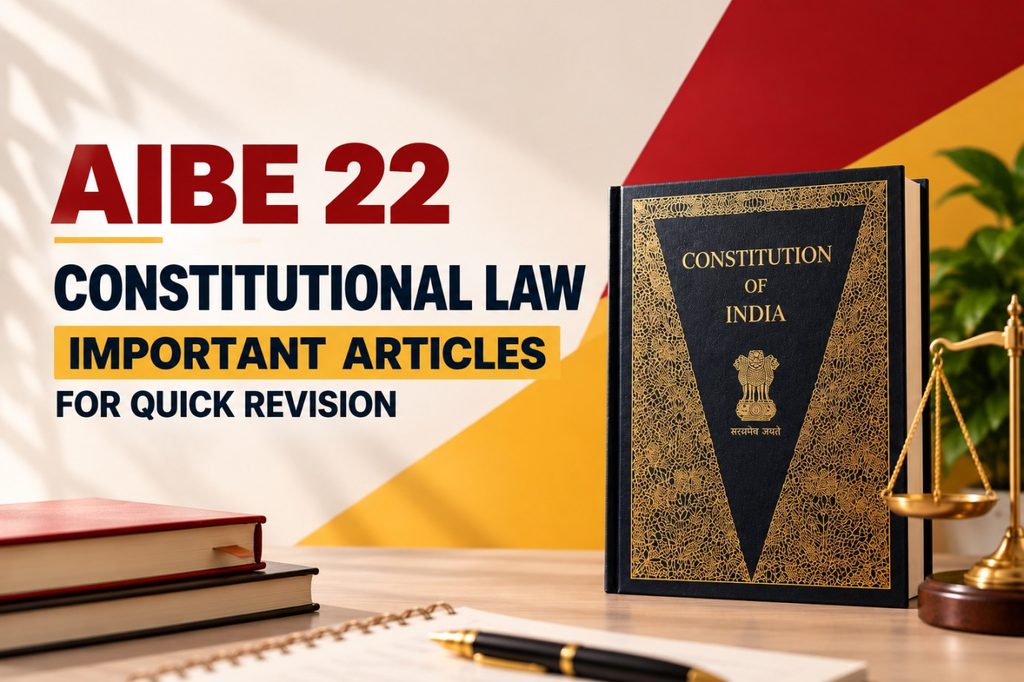
Constitutional law is one of the heavier subjects in the bar exam, and this AIBE 22 Constitutional Law guide puts the important articles of the Constitution of India, 1950 in one place. It is written for law graduates who have studied the subject and need a fast, organised recap. It also works as a Constitution of India articles list for quick revision. Legal terms are explained in plain words as they appear.
Main article: AIBE 22 Exam 2026: Complete Guide to Dates, Registration, Syllabus, and Eligibility
AIBE 22 Constitutional Law: Fundamental Rights (Part III)
Fundamental rights are basic freedoms guaranteed against State action and enforceable in court.
| Article | Key point |
|---|---|
| 12, 13 | “State” defined; laws violating fundamental rights are void |
| 14 | Equality before law and equal protection of laws |
| 15, 16 | No discrimination; equal opportunity in public jobs; reservation and EWS clauses |
| 17, 18 | Untouchability and titles abolished |
| 19 | Six freedoms: speech, assembly, association, movement, residence, profession |
| 20 | Protection against retrospective penal laws, double jeopardy, self-incrimination |
| 21, 21A | Life and personal liberty; free education for ages 6 to 14 |
| 22 | Safeguards on arrest; preventive detention rules |
| 23, 24 | Ban on trafficking, forced labour, child labour in hazardous work |
| 25 to 28 | Freedom of religion |
| 29, 30 | Minority cultural and educational rights |
| 32 | Right to constitutional remedies |
The 44th Amendment (1978) removed the right to property from Part III. Article 300A now treats it as an ordinary legal right.
Writs: Article 32 vs Article 226
A writ is a formal court order. The five writs are habeas corpus (produce a detained person), mandamus (command to perform a public duty), prohibition (stops a lower court), certiorari (quashes an order) and quo warranto (questions a person’s right to a public office).
| Feature | Article 32 | Article 226 |
|---|---|---|
| Court | Supreme Court | High Courts |
| Scope | Fundamental rights | Fundamental and other legal rights |
| Nature | Itself a fundamental right | Constitutional power |
Directive Principles and Fundamental Duties
Directive Principles (Part IV, Articles 36 to 51) guide the State but cannot be enforced in court. Key ones are Article 39A (free legal aid), Article 40 (village panchayats), Article 44 (Uniform Civil Code) and Article 48A (environment). Fundamental duties sit in Article 51A (Part IVA), added by the 42nd Amendment, 1976. The same amendment added “socialist”, “secular” and “integrity” to the Preamble.
Union Executive, Parliament and Courts
- President: Articles 52 and 53; impeachment Article 61; pardon Article 72; ordinances Article 123
- Council of Ministers: aids and advises the President, Article 74
- Parliament: Article 79; joint sitting Article 108; money bills Article 110
- Governor: Article 153; pardon Article 161; ordinances Article 213
- Supreme Court: Article 124; special leave Article 136; complete justice Article 142; advisory opinion Article 143
- High Courts: Articles 214 and 226
- Elections: Article 324 (Election Commission); Article 326 (adult suffrage at 18)
- Civil servants: safeguards in Article 311
Federalism, Emergency and Amendment
The Seventh Schedule divides law-making powers into the Union, State and Concurrent Lists (Articles 245 to 254). Residuary power, meaning subjects on no list, rests with the Union under Article 248. Local government is covered by Part IX (panchayats, 73rd Amendment) and Part IXA (municipalities, 74th Amendment).
Emergency provisions:
- National emergency: Article 352
- Failure of State machinery (President’s Rule): Article 356
- Financial emergency: Article 360
Rights under Articles 20 and 21 cannot be suspended during an emergency.
Amendment under Article 368:
Bill in either House → Special majority (two thirds present and voting,
plus majority of total membership) → Ratification by half the States
(for federal features) → President’s assent
Recent Amendments to Revise
- 101st (2016): GST, Article 246A
- 103rd (2019): 10% EWS reservation, Articles 15(6) and 16(6)
- 106th (2023): Nari Shakti Vandan Adhiniyam, one third seats for women in the Lok Sabha and State Assemblies, effective after delimitation (redrawing of constituencies)
FAQs
Prep guides rank it among the heavier ones. Check the official pattern for numbers.
No, but the State must consider them while making laws.
Article 32 is the Supreme Court’s writ power. Article 226 is wider and belongs to High Courts.
Rights can be suspended, except Articles 20 and 21.
No. It is a legal right under Article 300A.
Some of the top books for AIBE:
- R.V. Kelkar’s Lectures on Criminal Procedure: Based on Bharatiya Nagarik Suraksha Sanhita, 2023
- V. P. Sarathi’s Law of Evidence: Based on Bharatiya Sakshya Adhiniyam, 2023
- B.M. Gandhi’s Penal Law: Covering Bharatiya Nyaya Sanhita 2023, Dowry Prohibition Act, JJ Act, MTP Act, POCSO Act, DV Act, and More
- EBC’s Master Guide To All India Bar Examination (AIBE Exam Guide)
- All India Bar Examination Bare Acts Without Notes and Comments | AIBE Bare Acts Combo Set of 25 Books | Covering Old and New Criminal Laws
- All India Bar Examination – Solved Papers 2015-2025
- Universal’s Guide to All India Bar Examination | AIBE Complete Syllabus Guide