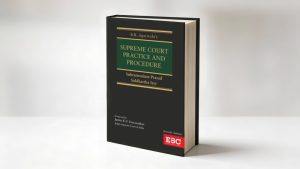
Even with AI transforming legal research, legal referencers remain essential for modern lawyers. AI tools are fast, but referencers provide the depth, accuracy, and reliability that legal practice demands. Here’s a simple, structured breakdown of why both still matter — and why referencers cannot be replaced.
Referencers Offer Authority and Reliability
AI tools generate answers using patterns, but legal work requires verified sources.
Referencers are curated by experts and follow strict editorial standards, which makes them:
- factually reliable
- citation-accurate
- court-acceptable
For pleadings, drafting, and arguments, lawyers rely on authoritative references, not algorithmic approximations.
They Provide Clear Statutory and Case Law Mapping
A legal referencer organizes information in a systematic, predictable structure, helping lawyers quickly connect:
- Sections and Articles
- Relevant doctrines
- Landmark cases
- Judicial trends
This structured mapping makes complex topics easy to navigate — something AI summaries often flatten or oversimplify.
They Preserve Doctrinal Evolution
Constitutional and statutory meanings evolve over decades.
Referencers show:
- origin of a principle
- major turning points
- overrulings
- current legal position
AI tools may give the current answer, but referencers give the entire journey, which helps lawyers understand the reasoning behind the law.
Precise Citations Matter — And Referencers Ensure Them
Courts expect:
- exact case titles
- pinpoint paragraphs
- correct statutory references
Referencers are built for perfect citation accuracy, while AI can occasionally miss or misformat references.
For courtroom work, precision is non-negotiable.
They Build Strong Legal Understanding
AI delivers quick summaries.
But referencers:
- build conceptual clarity
- strengthen legal reasoning
- help students and lawyers understand the “why” behind the law
This deeper foundation is essential for drafting, opinions, and advocacy.
AI Tools Are Helpful, But They’re Not Always Up-to-Date
AI databases depend on:
- updates
- integrations
- training data
Legal referencers, especially updated editions, guarantee current, validated information, reducing the risk of relying on outdated interpretations.
They Prevent Over-Reliance on AI
Relying only on AI may lead to:
- missed nuances
- misunderstood doctrines
- incorrect applications
Referencers act as a safety check, ensuring the lawyer’s understanding stays rooted in actual law, not automated assumptions.
For lawyers who want trusted, court-ready references, the Supreme Court Cases (SCC) Back Volumes Set remains one of the most reliable and authoritative resources.
You can explore it here: Supreme Court Cases (Bound Volumes) (SCC Back Volumes from 1969 to 2025)