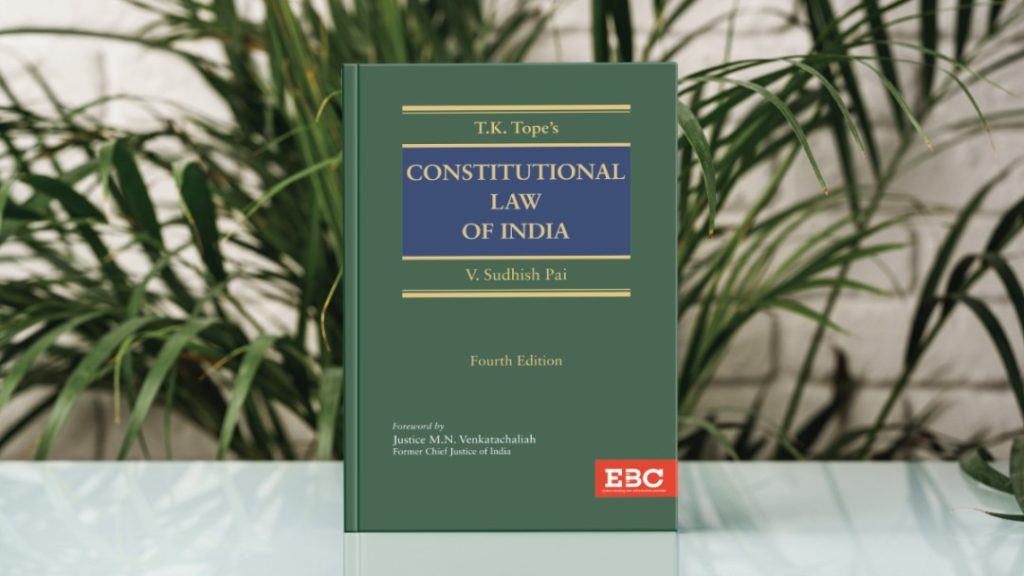
Understanding the Constitution of India can feel overwhelming because of its length, complexity, and constantly evolving judicial interpretation. This is where T.K. Tope’s Constitutional Law of India, now revised by V. Sudhish Pai, stands out as one of the most trusted and insightful works on constitutional law in India. For decades, this book has served as a reliable companion for judges, lawyers, scholars, and students, helping them understand not just what the Constitution says, but how it truly works in practice.
Originally authored by T.K. Tope, this classic work is known for its clear explanation of constitutional principles, rather than merely listing judgments. It explains the spirit, structure, and functioning of the Indian Constitution in a way that is both scholarly and easy to grasp.
What Makes This Book Special?
Unlike many constitutional law books that focus heavily on case citations, this book takes a principle-based approach. It helps readers understand:
- How the Constitution limits and controls government power
- How fundamental rights protect citizens
- How balance is maintained between the Legislature, Executive, and Judiciary
- How constitutional principles have evolved through judicial interpretation
The author explains why certain constitutional doctrines exist and how courts apply them, making the learning meaningful rather than mechanical.
What’s New in the Revised Edition by V. Sudhish Pai?
The latest edition, revised by V. Sudhish Pai, brings the book fully in tune with modern constitutional developments while preserving its classical strength. Key updates include:
1. A New Chapter on Constitutionalism
A completely new chapter on Constitutions, Constitutional Law, and Constitutionalism has been added. This helps readers understand:
- What a constitution truly represents
- The idea of limited government
- The role of constitutional values in democracy
2. Updated with Recent Supreme Court Judgments
The edition incorporates important recent decisions of the Supreme Court of India, ensuring that readers stay updated with current constitutional interpretation.
3. Focus on Principles, Not Case Overload
Rather than burdening readers with hundreds of case references, the book:
- Extracts the core constitutional doctrines
- Explains their meaning and application
- Shows how those principles shape India’s legal system
This makes the book ideal not only for examination purposes but also for real-life legal practice.
A Special Edition Marking 75 Years of the Constitution and the Supreme Court
The timing of this edition makes it even more meaningful. Its release coincides with the 75th anniversary of the Constitution of India and the Supreme Court of India, making it a symbolic and timely contribution to India’s constitutional discourse. It reflects on:
- The endurance of the Constitution
- The growth of constitutional jurisprudence
- The changing role of the judiciary in a modern democracy
Who Should Read This Book?
This book is not limited to one group of readers. It is highly useful for:
- Law students, for building strong conceptual foundations
- Judges and advocates, for clear doctrinal understanding
- Academicians and researchers, for analytical study
- Civil services aspirants and informed citizens, for understanding the working of Indian democracy
Whether you are preparing for exams, court arguments, academic work, or simply wish to understand how the Constitution shapes governance in India, this book serves as a trusted guide.
Why This Book Continues to Be a Classic
For over four decades, this book has remained relevant because it:
- Explains the Constitution as a living document
- Balances theory with real judicial application
- Maintains clarity without oversimplifying the law
- Continues to evolve with changing constitutional challenges
It does not treat the Constitution as a rigid text, but as a dynamic instrument that grows with society.
T.K. Tope’s Constitutional Law of India, revised by V. Sudhish Pai, is more than just a textbook—it is a thoughtful journey through India’s constitutional soul. With its focus on core principles, updated judicial developments, and deep constitutional insight, it remains an indispensable resource for anyone serious about understanding Indian constitutional law.
If you are looking for a book that explains not just what the law is, but why it exists and how it works, this remains one of the finest choices in constitutional scholarship.